Financial accounting (cert.) (Region Westschweiz):
3 Provider



The following list shows you various "Financial Accounting (Cert.)" courses:
Strehlgasse 2
8001 Zürich
 Strengths:
Our training courses are 100% online and therefore offer maximum flexibility. At the same time, you benefit from personal support from our experts.
Strengths:
Our training courses are 100% online and therefore offer maximum flexibility. At the same time, you benefit from personal support from our experts.

 Download info
Strengths:
The Institute for Vocational Education and Continuing Education, Further Training IBAW offers high-quality and practical training programs for private individuals and companies/institutions throughout Switzerland.
Download info
Download info
Download info
Strengths:
The Institute for Vocational Education and Continuing Education, Further Training IBAW offers high-quality and practical training programs for private individuals and companies/institutions throughout Switzerland.
Download info
Download info
Schools with certified educational counseling

Questions and answers
Best practice in financial accounting: what is the purpose?
Financial accounting (best practice) fulfills central tasks in every company. It is far more than a legal obligation - it provides the basis for business decisions.
The most important purposes of financial accounting at a glance:
- Determine the overall result: Financial accounting shows whether a company has made a profit or loss in a particular accounting period.
- The statement of financial position: It provides information on the current assets and liabilities of a company.
- Document inventory changes: Changes in assets and liabilities are systematically recorded and made traceable.
- accountable: Accounting provides reliable data for tax authorities, investors, banks and other interest groups.
- Basis for planning and control: Budgets can be drawn up, investments planned and operational processes optimized on the basis of the financial figures.
These tasks show how important correctly managed financial accounting is for healthy company growth. Based on best practice in financial accounting.
Note: The exact weighting of content and teaching of best practice topics in financial accounting may vary from school to school. For binding information on a specific course, we recommend contacting the relevant educational institution directly. Use the contact form to send the question directly to the desired school.
What is financial accounting simply explained?
Financial accounting is a central component of operational accounting. It documents all business transactions that can be recorded in figures and thus forms the basis for many operational decisions.
Financial accounting explained simply:
- Part of accounting that deals with the complete recording of all financial business transactions
- Includes all expenses and income of a company
- Provides a systematic and chronological overview of income and expenses
- In larger companies, subdivided into accounts payable (incoming invoices) and accounts receivable (outgoing invoices)
The classification "Financial accounting simply explained" helps to present the economic situation of a company in a comprehensible and transparent manner at all times - both for internal purposes and for external bodies such as tax authorities or investors.
Important to know:
The exact definition and application of financial accounting (simply explained) may vary slightly depending on the educational institution or course. For binding information, it is worth contacting the respective school directly.
Still have questions about financial accounting or a specific course?
Simply use the contact form - the request will be forwarded directly to the desired school.
Fi Bu: What is done in financial accounting?
Financial accounting (Fi Bu) is a central component of accounting and systematically documents all of a company's financial transactions. The focus is on all income and expenses that lead to a cash flow. The aim is to present the economic success of a company in a transparent and comprehensible manner.
Typical areas of responsibility in financial accounting (Fi Bu):
- Record income and expenses: All payments are recorded chronologically - whether cash payment, bank transfer or card transaction.
- Maintaining the general ledger: This contains all business transactions that have an impact on the balance sheet and income statement.
- Preparation of balance sheet and income statement: At the end of each financial year, the financial results are summarized and disclosed.
- Working with subledgers: These include, for example, accounts receivable (receivables from customers) and accounts payable (payables to suppliers).
- Compliance with legal requirements: Companies with an annual turnover of over CHF 500,000 are obliged to keep double-entry bookkeeping, including annual financial statements.
These financial accounting (Fi Bu) tasks provide a clear overview of a company's financial situation and serve as a basis for strategic decisions, tax obligations and communication with external parties such as banks or investors.
Important: The specific content and focus of a course in financial accounting (Fi Bu) can vary depending on the school. To ensure that a course meets your personal expectations, it is worth asking the respective educational institution directly. The question can simply be forwarded to the desired school using the contact form.
What types of financial accounting training are there?
Financial accounting training is versatile and is aimed at different target groups - from beginners to experienced specialists. Depending on prior knowledge, professional orientation and learning objectives, there are different types of courses to choose from:
- Basic course in financial accounting
Teaches the most important basics and is suitable for beginners or people with little previous knowledge. - Course for advanced learners
Expands on existing knowledge and deals with more complex accounting processes and legal requirements. - Practical course in financial accounting
Focuses on practical application - ideal for anyone who wants to put what they have learned directly into practice in their day-to-day work. - Refresher course
Refreshes existing knowledge in a targeted manner, for example after a longer break or in preparation for an exam. - Software courses (e.g. ABACUS, Sage, Banana)
Training for working with industry-specific accounting software - practical and system-oriented. - Accounting courses (also in English)
Address international accounting standards and are often aimed at employees of globally active companies. - Courses on reporting and analysis
Teach techniques for analyzing financial data and creating professional reports for management.
These types of financial accounting training courses can vary depending on the provider or be offered in combination. The choice depends on the individual learning objectives and professional requirements.
Tip: Each school decides for itself on the content, course titles and requirements for the financial accounting course. The exact structure can therefore only be clarified directly with the respective educational institution.
Question still open?
With our contact form, the request for financial accounting training is forwarded directly to the desired school
What do you learn in a financial accounting course?
A financial accounting course provides practice-oriented knowledge for getting started in accounting and creates a solid foundation for further business management tasks. Typical contents are
- Fundamentals of financial accounting (FiBu): Introduction to accounting terms, principles and objectives.
- Legal framework: Overview of relevant laws and regulations that must be observed in accounting.
- Structure and organization of bookkeeping: How bookkeeping is organized, including the structure of a chart of accounts.
- Account assignment and posting of business transactions: Practical exercises for the correct allocation and posting of various business transactions.
- Introduction to costing, foreign currencies and interest calculation: basic knowledge of cost accounting, dealing with currencies and calculating interest.
This course is ideal for anyone who deals with figures in their job or wants to prepare for a career in accounting. The knowledge imparted is valuable in both private and professional practice.
Important: Each school determines the specific course content individually. It is therefore advisable to ask your chosen school directly which topics are actually covered in the course.
Use our contact form to forward your question directly to the relevant school - quickly and easily.
What are the financial accounting basics?
Financial Accounting Basics teaches key skills for understanding and applying accounting. Typical contents of a corresponding course are
- Accounting basics: Introduction to key terms and principles of double-entry bookkeeping
- Processing business transactions: Dealing with chart of accounts, VAT and goods accounts in practical accounting
- Account system: structure and function of balance sheet and income statement accounts
- Income statement: Presentation of expenses and income to determine the company's result
- Opening balance sheet: Preparation and interpretation of an opening balance sheet as the starting point for accounting
These topics form the basis for further courses and professional activities in finance and accounting. The specific content of the financial accounting basics can vary depending on the provider.
Important: The exact composition and depth of the topics in Financial Accounting Basics is determined individually by each school. For binding information, it is advisable to enquire directly with the desired school. Using our contact form, the question can be easily forwarded to the appropriate school.
What is the difference between financial accounting (FiBu) and operational accounting (BeBu)?
Accounting is divided into two main areas: financial accounting (FiBu) and operational accounting (BeBu). Both fulfill different tasks and provide important information for different target groups in the company.
- Financial accounting (FiBu):
It is required by law and documents all of a company's business transactions - i.e. expenses, income, assets and liabilities. The aim is to create an overview of the financial situation that is as accurate and comprehensible as possible, which is also relevant for external stakeholders such as tax authorities or investors. - Operating accounting (BeBu):
It is voluntary and focuses on the internal view. It shows exactly where costs are incurred, which services are provided and how economically individual areas operate. The BeBu primarily serves as an internal management tool for company management.
To summarize:
While financial accounting is externally oriented and complies with legal requirements, financial accounting provides detailed information for optimizing processes and costs within the company.
Together, both types of accounting form the basis for well-founded decisions, investment planning and sustainable corporate development.
The content covered in detail in a financial accounting or management accounting course can vary from school to school. Each educational institution determines how the focus is set. Use our contact form to forward your question directly to the desired school.
How long does continuing education, further training in financial accounting take?
The duration of the financial accounting training depends on the type of training:
- One day or a few days for a basic course
- usually 2 semesters for accounting clerks
- 3 to 6 semesters for finance and accounting specialists
Ask the school offering the course of your choice about the specific duration.
Tips, tests and information on "Financial accounting (cert.)"

 Error found? -
Experiences, evaluations and opinions on training / further education
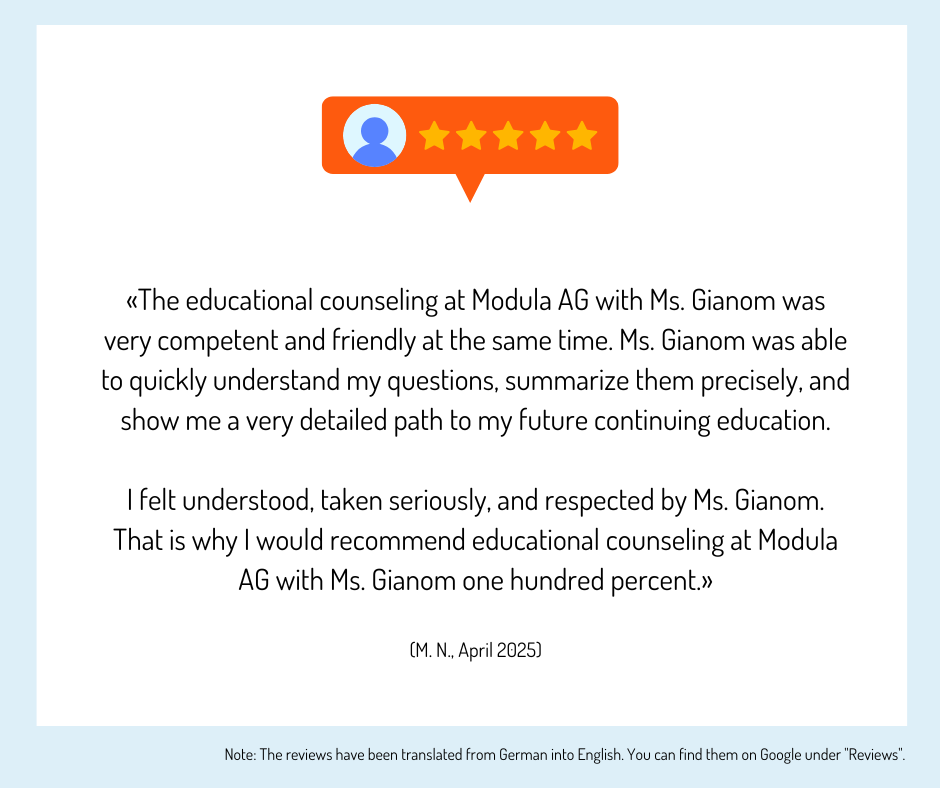
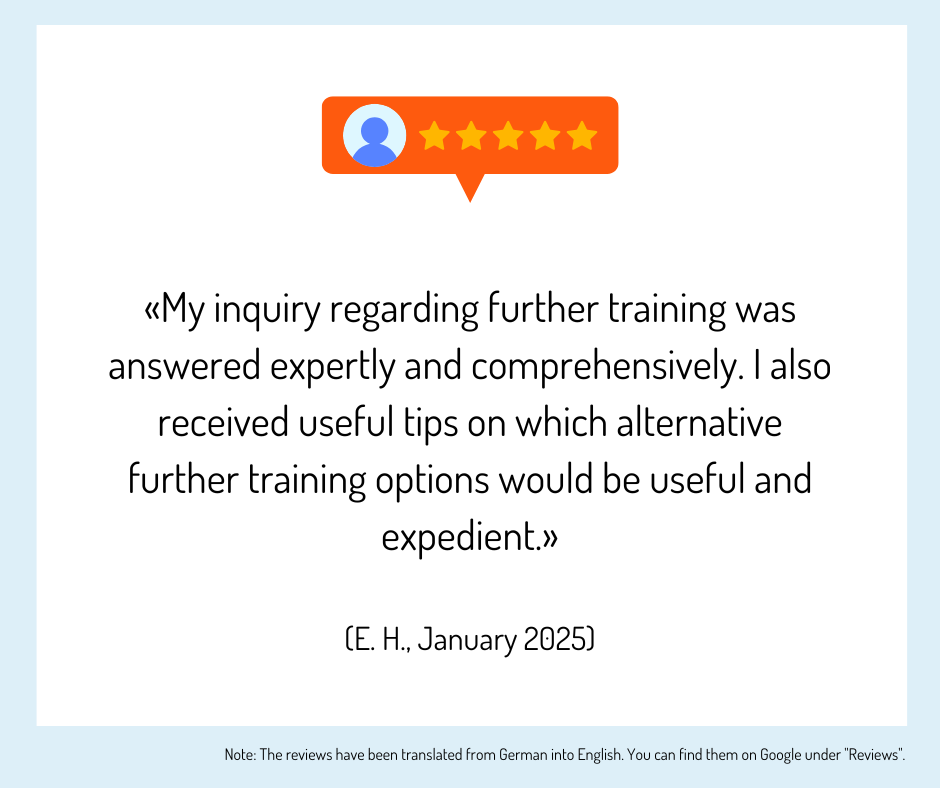
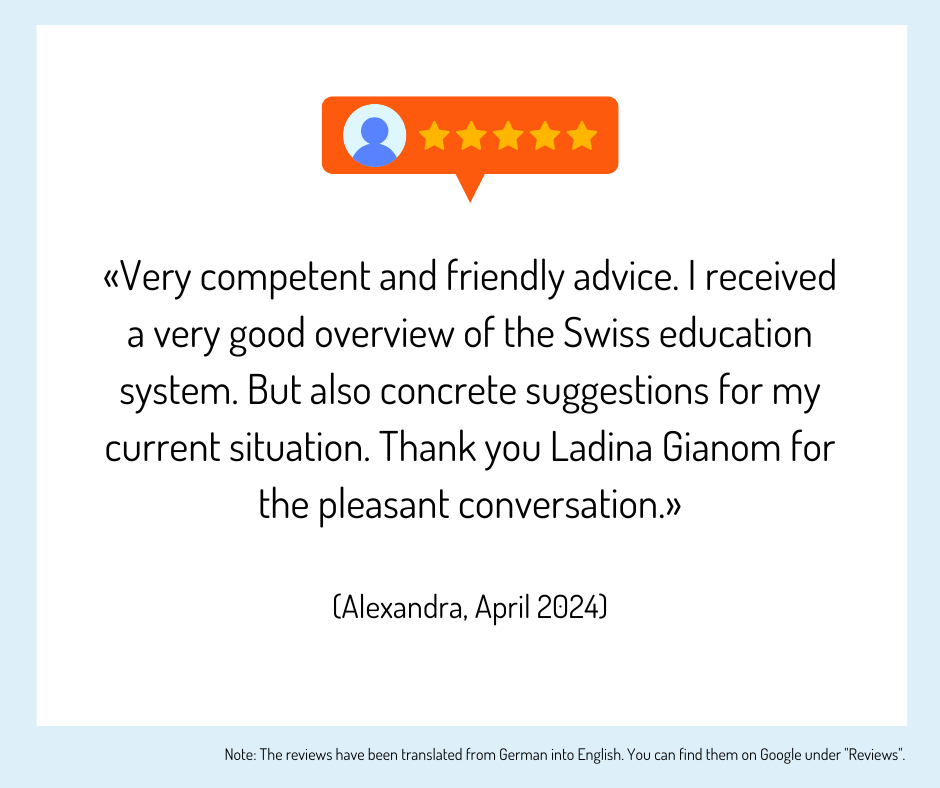
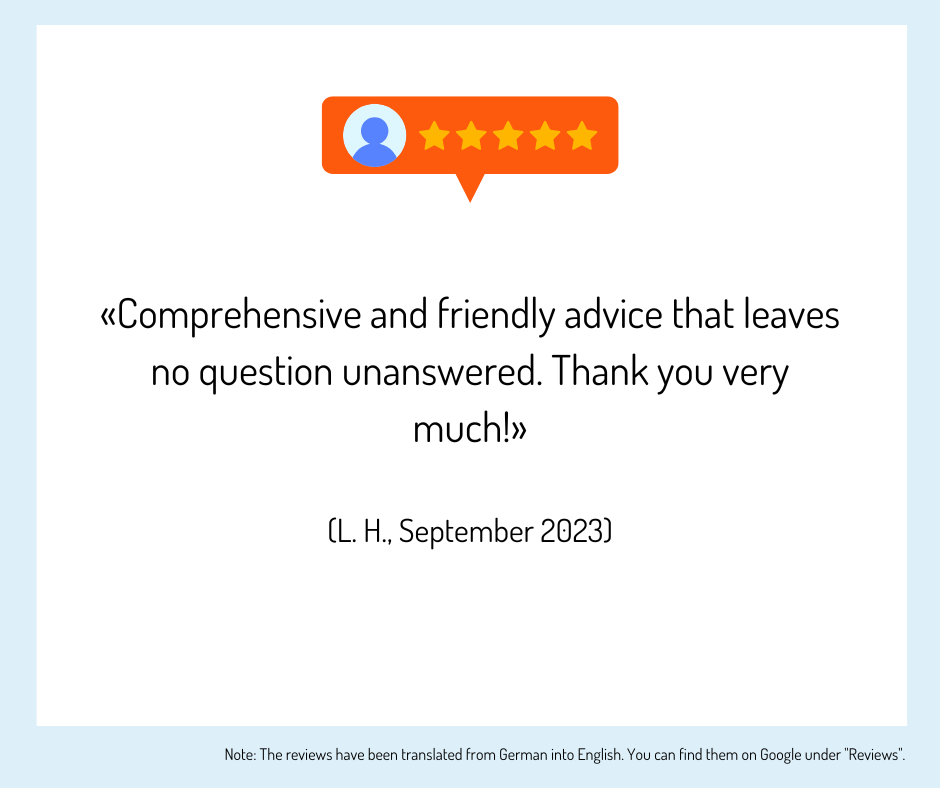
Haven't found the right training or further education yet? Benefit from educational advice now!
Further training is not only important in order to maintain or increase professional attractiveness, investing in training or further training is still the most efficient way to increase the chances of a pay rise.
The Swiss education system offers a wide range of individual training and further education opportunities - depending on your personal level of education, professional experience and educational goals.
Choosing the right educational offer is not easy for many prospective students.
Which training and further education is the right one for my path?
Our education advisory team will guide you through the "education jungle", providing specific input and relevant background information to help you choose the right offer.
Your advantages:
You will receive
- Suggestions for suitable courses, seminars or training programs based on the information you provide in the questionnaire
- An overview of the different levels and types of education
- Information about the Swiss education system
We offer our educational counseling in the following languages on request: French, Italian, English
Register now and concretize your training plans.





Attraktive Services für Swisscom Mitarbeitende
Kostenlose Services
» Bildungsberatung (Wert: CHF 150.–)
Bildungs- und Businessratgeber (Wert: CHF 175.–)
» Rabatte
Attraktive Rabattierungen seitens der Bildungsanbieter.
» Massgeschneiderte Bildungsangebote
Ohne grossen Zeitaufwand den besten Trainer, Coach oder Schulungsanbieter finden
Bildungsangebot Schweiz
Aus über 700 Bildungsanbietern das richtige Bildungsangebot finden