Accounting Clerk / Accounting Assistant / Accounting Assistant (Certified) (Rapperswil):
2 Provider - 3 Training locations

Immediately to the right training
Andreasstrasse 15
8050 Zürich
 Strengths:
Largest provider of HFW in Switzerland. 11 locations (incl. online location), modern learning methods and practical continuing education, further training with a focus on business, IT and digital skills for the future
Strengths:
Largest provider of HFW in Switzerland. 11 locations (incl. online location), modern learning methods and practical continuing education, further training with a focus on business, IT and digital skills for the future

 Download info
Bahnhofplatz 2
9000 St. Gallen
 Experiences of Swisscom employees about this course and this school.
» More info…
Experiences of Swisscom employees about this course and this school.
» More info…

Schools with certified educational counseling

Sites in the region Eastern Switzerland and Rapperswil:
Education location / Schools Rapperswil Jona
Questions and answers
What is the difference between bookkeeping and accounting?
The difference between bookkeeping and accounting lies in their scope and function:
TheAccountingis a sub-area of accounting. It primarily comprises the systematic recording of all financial transactions of a company (e.g. income, expenses, assets, liabilities) in chronological order. This activity is usually carried out in accordance with legal regulations, such as the Swiss Code of Obligations (OR).
TheAccountingis the overarching term and, in addition to accounting, also includes other areas such as:
- Financial accounting (FIBU)
- Management accounting (BEBU)
- Cost and activity accounting
- Planning, control and reporting (controlling)
- Annual financial statements and analysis
The aim of accounting is to provide a sound basis of information for business decisions and to present the financial situation of a company in a transparent manner.
Accounting clerk distance learning course: What does it look like?
A distance learning course to become an accounting clerk teaches the course content in the form of structured self-study and therefore does not require attendance at a school. This means that the course can be completed at any time and from any location. The individual study program takes about the same amount of time as the classroom-based course. Of course, if someone invests a lot of time in training, the distance learning course to become an accounting clerk can also be completed in less time. Thanks to its high degree of flexibility, a distance learning course offers a good work-life balance. Other advantages include lower costs, equal recognition and the respect of many employers. However, distance learning also requires good planning, perseverance and a lot of self-motivation. The exchange with other students, group work and building a network is more difficult with this form of learning. When choosing your form of education, be honest with yourself and consider your needs and your learning style. Then you will find it easier and more relaxed to complete your studies to become an accounting clerk.
What do participants learn in the Accounting Clerk Further Training Program?
The Accounting Clerk for Continuing Education provides practical, fundamental knowledge for working in financial accounting and management accounting. The program focuses in particular on financial accounting, value-added tax, social insurance, and financial management.
Typical learning contents are
- Financial Accounting and Double-Entry Bookkeeping: Fundamentals of double-entry bookkeeping, account management, accounts receivable and accounts payable, recording daily transactions, annual financial statements
- Value added tax: application of the Swiss Value Added Tax Act, invoicing and special features
- Social insurance: Contributions and benefits of AHV, IV, ALV, BVG and their settlement
- Financial Management and Key Performance Indicators: Fundamentals of Corporate Financial Management and Budgeting
- Cost accounting: calculation, contribution margins, internal allocation and cost control
- Preparatory work for financial statements
The continuing education, further training Accounting Clerk is equipped to independently and competently handle operational tasks in financial and general ledger accounting. This program helps students better understand financial relationships within a company and lays a solid foundation for a future career in accounting. Read more about otherAdvantagestraining.
Important: The specific content may vary slightly depending on the school. It is therefore advisable to enquire about the detailed content of the accounting clerk continuing education, further training course directly with the desired school. Specific questions can be asked via our contact form. The request will be automatically forwarded to the selected school
What career opportunities does an accounting clerk have?
As an accounting clerk, various continuing education, further training courses in finance are open to you. The Federal Diploma of Higher Education in Finance and Accounting is particularly common.
These continuing education, further training courses enable specialization and promotion to more responsible positions.
It is important to note that:
- The Accounting Clerk training program is not automatically a prerequisite for the professional certification.
- Separate eligibility requirements apply to the Federal Professional Examination.
- This includes, in particular, certain types of work experience and prior education.
- Depending on the certificate and the educational provider, there may be different options for continuing your education.
- The specific admission requirements should be reviewed before beginning the continuing education, further training program.
Typical connection options:
- Specialist in finance and accounting with a federal diploma
- Continuing education, further training in controlling
- CAS in the financial sector
- Specialization in fiduciary services
Conclusion:
If you plan to earn the Swiss Federal Certificate in the long term, you should consider the course content and opportunities for further study when choosing an administrative assistant training program. See also the FRecords from the Educational Counseling Office.
How are digitalization and AI changing the work of accounting professionals?
Digital accounting systems, automated processes, ERP solutions, and, increasingly, AI are transforming day-to-day work in accounting. Routine tasks can be partially automated, while verification, interpretation, and subject-matter expertise are becoming more important.
Among other things, the following are gaining in importance:
- Digital Document Processing
- automated postings
- Cloud-based accounting
- ERP Systems
- Electronic Invoicing Processes
- Automated Reconciliations
- Data Validation and Plausibility Checks
- Analyses and Reports
- Secure Handling of Financial Data
Digitalization does not make accounting expertise obsolete. Rather, companies are looking for employees who understand accounting processes, can confidently use digital systems, and are able to professionally evaluate automated results.
What does an accounting clerk do?
An accounting clerk performs a wide range of tasks in the area of financial accounting and ensures that the company's financial processes are managed correctly and efficiently. The precise recording, control and evaluation of figures is at the heart of their work.
Typical areas of responsibility are
- Bookkeeping: recording business transactions, account assignment of documents, keeping general ledgers and subsidiary ledgers
- Balance sheet and profit and loss account: involvement in monthly, quarterly and annual financial statements
Cost center accounting and payroll calculations: Allocation of costs, support with payroll accounting - Dunning and tax law: creating reminders, processing payments and arrears, complying with tax regulations
- Working with key figures: Evaluation of key business figures to support the management
- Administrative tasks: Filing, documentation, correspondence and maintenance of master data and systems
Accounting clerks work closely with other departments, e.g. Controlling, Human Resources or external bodies such as trustees and auditing companies.
The position requires precision, a sense of responsibility, and strong numerical skills. In addition, knowledge of accounting software and current legal requirements is an important part of theEveryday Work Life.
What kinds of jobs can you do after completing the Accounting Clerk training program?
With further training in accounting administration, candidates are primarily qualified for operational roles in bookkeeping, financial administration, and accounting. The kspecific tasksdepend on one's educational background, work experience, and position.
Possible roles for graduates of the Accounting Clerk training program include, for example:
- Accounting Clerk (Male) / Accounting Clerk (Female)
- Accounting Clerk (Male) / Accounting Clerk (Female)
- Financial Accounting Clerk (Male) / Financial Accounting Clerk (Female)
- Accounts Payable or Accounts Receivable Clerk / Accounts Payable or Accounts Receivable Clerk (female)
- Financial Clerk (Male/Female)
- Accounting Assistant
- Accounting Assistant (Male/Female)
- Junior Accountant
The Accounting Clerk training program can make it easier to enter or transition into a career in accounting. More demanding specialized and management roles generally require additional work experience and advanced qualifications.
How long does it take to complete an apprenticeship as an accounting clerk?
The duration of the training program to become an accounting clerk depends on the educational provider, the teaching model, and the degree awarded. Many programs are designed to be taken while working and last approximately two to three semesters.
Possible models include:
- Classes over the course of two to three semesters
- Evening or Day Classes
- Saturday Classes
- Classroom teaching
- hybrid or partially digital teaching models
- Modular courses with different exam dates
In addition to class time, you should set aside time for preparation and follow-up work, as well as for studying for exams.
In many cases, the training program to become an accounting clerk can be easily completed while working. How much time you’ll actually need depends on the course, your prior knowledge, and your personal learning pace. Read more about possibleDisadvantagestraining.
How much does the continuing education program for accounting clerks cost?
The costs of further training for accounting clerks vary depending on the educational provider, the degree, the teaching model, and the services included. In addition to course fees, there may be costs for teaching materials, exam fees, or additional preparatory courses, for example.
When planning your budget, you should pay particular attention to the following:
- Course fees
- Fees for Certificate or Final Exams
- Teaching Aids and Instructional Materials
- Costs for any prerequisite courses
- Costs for Private Lessons
- possible discounts or benefits
- Requirements for any future continuing education, further training
When choosing a school, don't just compare the advertised course price—consider the total cost of the program. You should check the specific fees for the Accounting Clerk continuing education, further training program directly with the respective provider.
Read more aboutAdvantagesandDisadvantagestraining
How much does an accounting clerk earn?
The salary for an accounting clerk in Switzerland varies depending on experience, company size, industry, and region. On average, the current gross annual income is around 72,000 to 73,000 Swiss francs. The specific salary amount can vary significantly depending on professional experience and qualifications. Current salary figures, for example, are around 71,500 Swiss francs per year.
As professional experience grows and individuals pursue continuing education or further training—such as becoming finance and accounting specialists with a federal certificate—salaries can increase significantly. Larger companies and economically strong regions, such as Zurich or Geneva, also often pay higher salaries.
It is important to note that in Switzerland, in addition to the base salary, employers may commonly offer additional benefits such as a 13th month’s salary, bonuses, pension fund contributions, and other social benefits. When reviewing salary information, you should therefore always check whether the 13th-month salary and variable compensation are already included in the reported annual salary.
Summary:
- Average annual gross salary: approximately CHF 71,500 per year
- Salary range: approximately CHF 72,000 to CHF 73,000
- Monthly income: depending on pay periods and the 13th-month salary, approximately CHF 5,500 or more
- Factors: Work experience, continuing education, industry, region, and company size
- Additional Benefits: Depending on the employer, a 13th month's salary, bonuses, a pension plan, and other social benefits
A solid education and ongoing continuing education in accounting offer good opportunities for acompetitive salaryand interesting career development opportunities. Through continuing education, further training programs such as the “Accounting Clerk” course offered by kv edupool or the “Accounting Clerk” course offered by VSH Management, participants can acquire additional specialized knowledge and enhance their career development opportunities.
Is the Accounting Clerk program for continuing education, further training federally recognized?
No. OneConclusionThere is no federal certificate for the position of accounting clerk. Depending on the program, the qualification may be, for example, a certificate or a professional association certification.
The differences are important:
- Accounting Clerk: Certificate or professional association certification, depending on the provider
- Finance and Accounting Specialist: Federal Certificate upon passing the Federal Professional Examination
- Expert in Accounting and Controlling: Federal Diploma following the Advanced Federal Professional Examination (AFPE)
The Accounting Clerk Continuing Education Program is a lower-level qualification and can serve as an entry point or preparation for more advanced continuing education programs. However, it should not be equated with a federal certification.
What are the requirements for training to become an accounting clerk?
The requirements for administrative-level training courses are not standardized throughout Switzerland. Many providers expect applicants to have business or comparable prior experience, or a basic understanding of financial accounting.
Depending on the provider of the accounting clerk training program, the following may be required or recommended, for example:
- Basic business training or comparable education
- Basic knowledge of financial accounting
- Professional experience in the commercial sector
- good knowledge of German
- Enjoy working with numbers
- Willingness to study and practice regularly
There are no general admission requirements for the accounting clerk training program that apply to all providers. Before applying, you should therefore check the specific requirements for the program you’re interested in. If you lack accounting knowledge, some schools offer preparatory courses.
Read more about the5 Factsabout training and take theSelf-test.
What degree do you receive after completing the continuing education program for accounting clerks?
Depending on the educational provider, the continuing education program for accounting clerks concludes with various certificates or professional association credentials. These include, for example, the “Accounting Clerk Diploma” from kv edupool, certifications from VSH Management, and programs offered by SwissAccounting. These certifications are not equivalent to a federal vocational certificate.
Please note:
- Not every provider leads to the same outcome.
- The names and tests may vary.
- Certificates issued at the administrative level are not equivalent to a federal professional certificate.
- You should check with the respective provider to find out the specific recognition policies and transfer options.
Before enrolling, it’s worth checking carefully what degree you’ll receive after completing the continuing education program for accounting clerks and whatMeaningthis has to offer for your next career move.
Accounting clerk self-study: How much time does it take?
In addition to the 4 to 8 hours of classroom instruction per week, the Accounting Clerk course requires additional time for individual study. The weekly learning effort for self-study in the continuing education, further training accounting clerk is a further 3 to 4 hours per week at home. This learning includes regular preparation and revision of the course material, solving case studies, dedicated participation in group work as well as learning group work for regular exchanges and targeted preparation for examinations. A detailed training concept for each subject sets out the intended learning objectives and content. This gives students a good overview of what needs to be completed at home during the accounting clerk self-study course. Of course, lecturers also point out useful supplementary learning content.
How do I become an accounting clerk?
You can become an accounting clerk with specific training:
- Awareness and image
- professional benefit
- Skills and perspectives
- 10 advantages
- Wages
- Experience participantsandExperience report from course leaders
- Self-test
- AdvisorField of education Accounting, controlling, fiduciary services
Personal Qualities for a Career in Accounting: What Do I Need to Become an Accounting Clerk?
For accounting positions, accuracy, a strong grasp of numbers, and a structured approach to work are particularly important. Reliability and a sense of responsibility also play a major role for accounting clerks, as they work with financial and, in some cases, confidential data.
Helpful qualities for an accounts payable clerk include:
- Enjoy working with numbers
- analytical thinking
- Accuracy and care
- Reliability
- Structured work
- Discretion
- Sense of responsibility
- good time management
- Interest in economic relationships
- Willingness to engage in regular professional development
Conclusion:
You don't have to be a "numbers person" in the traditional sense. If you like to work in a structured way, want to understand how things fit together, and handle data carefully, accounting might be a good fit for you.
See also theInformation from job advertisementsto.
In which industries do accounting clerks work?
Accounting clerks are needed in virtually every industry, since companies must organize their financial transactions and bookkeeping.
Possible areas of work include:
- SMEs and Large Companies
- Industry and Commerce
- Service Company
- Trust company
- Banks and insurance companies
- Real Estate Company
- Construction Company
- Healthcare
- Logistics companies
- public administration
One of the strengths of this profession is its cross-industry applicability. The specificTaskscan vary significantly depending on the industry and the size of the company.
Tips, tests and information on "Accounting clerk with Edupool certificate"


 Error found? -
Experiences, evaluations and opinions on training / further education
Haven't found the right training or further education yet? Benefit from educational advice now!
Further training is not only important in order to maintain or increase professional attractiveness, investing in training or further training is still the most efficient way to increase the chances of a pay rise.
The Swiss education system offers a wide range of individual training and further education opportunities - depending on your personal level of education, professional experience and educational goals.
Choosing the right educational offer is not easy for many prospective students.
Which training and further education is the right one for my path?
Our education advisory team will guide you through the "education jungle", providing specific input and relevant background information to help you choose the right offer.
Your advantages:
You will receive
- Suggestions for suitable courses, seminars or training programs based on the information you provide in the questionnaire
- An overview of the different levels and types of education
- Information about the Swiss education system
We offer our educational counseling in the following languages on request: French, Italian, English
Register now and concretize your training plans.
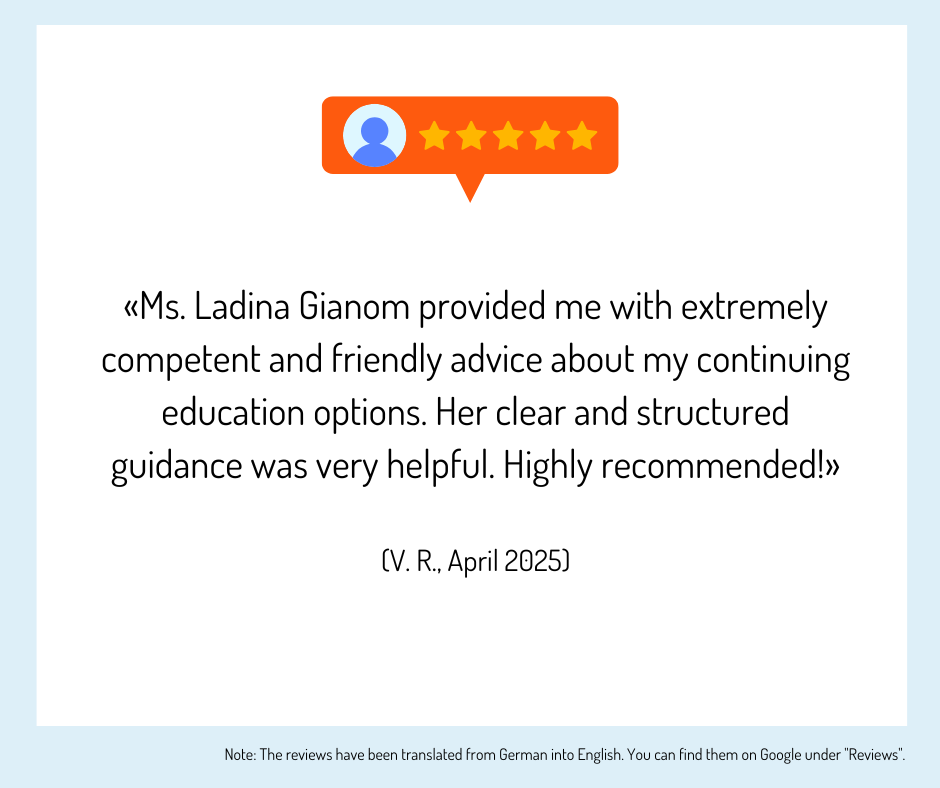
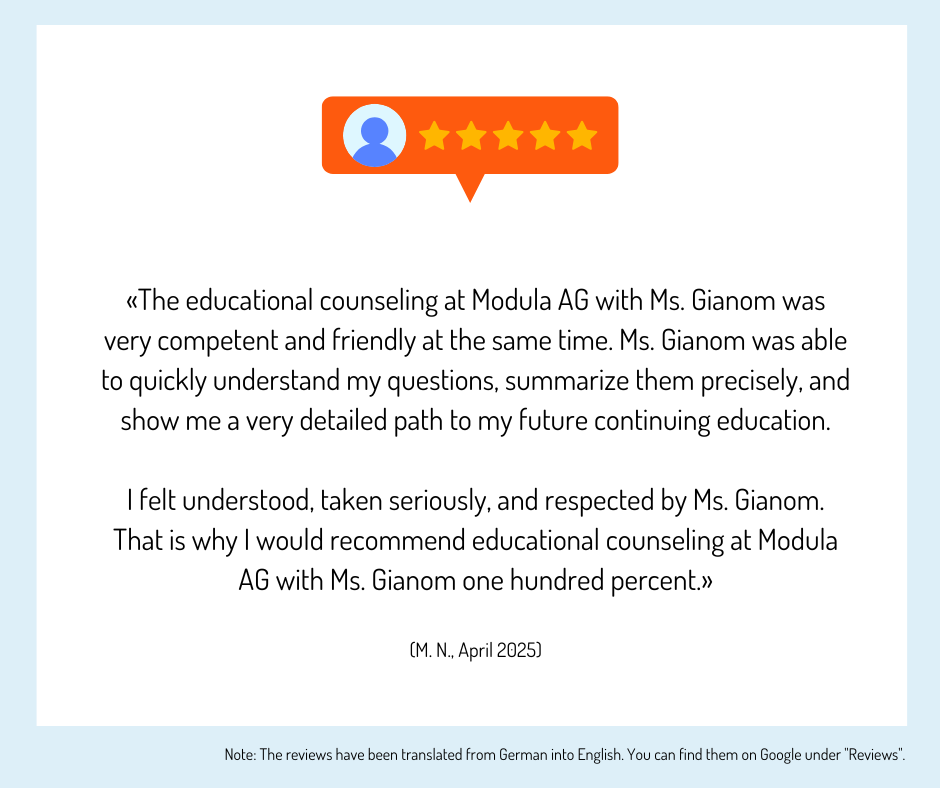
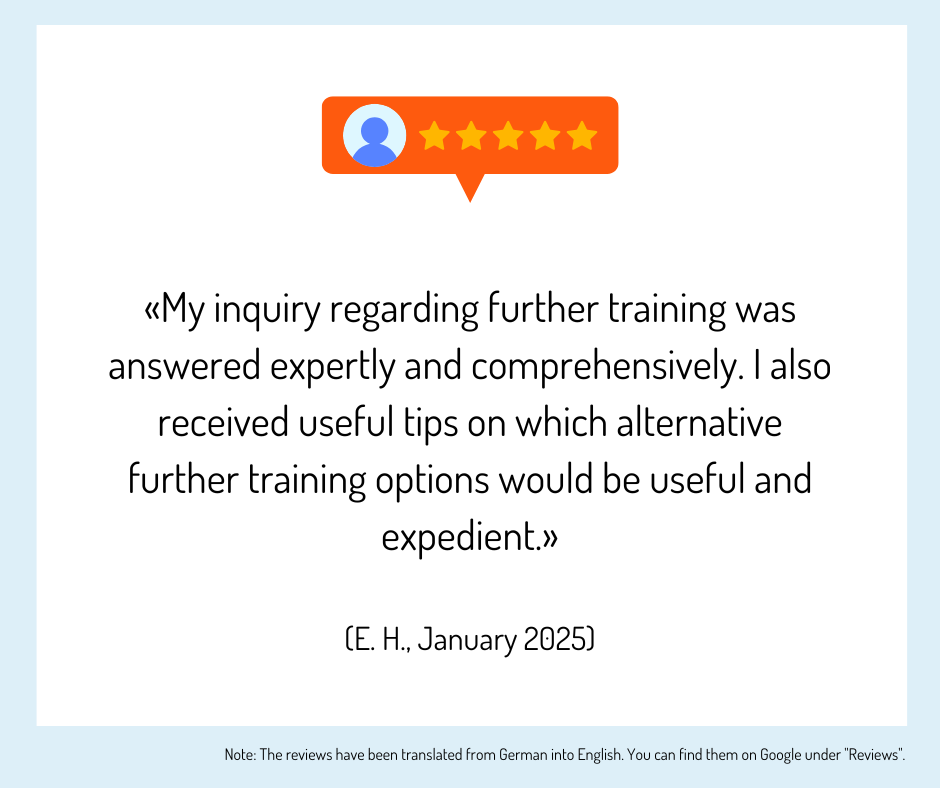
Course evaluations from participants on
Ich arbeite bereits seit ein paar Jahren in der Buchhaltung und war deshalb zuerst skeptisch, ob mir diese Weiterbildung wirklich noch etwas bringen würde. Eine Freundin von mir hat mir die SWS weiterempfohlen. Rückblickend bin ich sehr froh habe ich mich dafür entschieden. Ich habe so viel gelernt, was ich auch in meinem Arbeitsalltag nun täglich anwende und mich in meiner Karrierelaufbahn weiterbringen wird. Danke für alles!
| Organisation (5.0) | |
| Lecturers (6.0) | |
| Learning content (5.0) | |
| Training methodology (6.0) | |
| Infrastructure (6.0) |
Ich fand den Kurs richtig informativ. Ich habe viel gelernt was mich bei der Arbeitssuche geholfen hat und ich jetzt täglich nutze. Die Dozierenden waren immer sehr net und haben viel Selbsterfahrung in den Themen die sie beibringen. Ich fand die Flexibilität des Präsenz sowie Fernunterricht richtig gut, weil ich an tagen wo ich arbeiten musste oder von zuhause aus alles mitbekommen habe und in Fällen wo ich den Kurs komplett verpasst habe, konnte ich auch immer durch die Aufzeichnungen des Unterrichts vorankommen
| Organisation (5.0) | |
| Lecturers (6.0) | |
| Learning content (6.0) | |
| Training methodology (6.0) | |
| Infrastructure (6.0) |
Concernant l’évaluation, c’était une bonne expérience.
| Organisation (5.0) | |
| Lecturers (6.0) | |
| Learning content (5.0) | |
| Training methodology (6.0) | |
| Infrastructure (5.0) |
J’ai eu du plaisir à travailler avec la plateforme de BetterStudy et à préparer l’examen. Celui-ci ne reflétait toutefois pas suffisamment, à mon avis, les exercices effectués.
| Organisation (5.0) | |
| Lecturers (5.0) | |
| Learning content (5.0) | |
| Training methodology (6.0) | |
| Infrastructure (5.0) |
Les cours en ligne sont parfait, car on peut étudier depuis la maison à n'importe quelle heure.
| Organisation (6.0) | |
| Lecturers (6.0) | |
| Learning content (6.0) | |
| Training methodology (6.0) | |
| Infrastructure (6.0) |

Ich bin sehr zufrieden. Danke 😀
| Organisation (5.0) | |
| Lecturers (6.0) | |
| Learning content (6.0) | |
| Training methodology (6.0) | |
| Infrastructure (5.0) |
Sehr empfehlenswert
| Organisation (6.0) | |
| Lecturers (6.0) | |
| Learning content (6.0) | |
| Training methodology (5.0) | |
| Infrastructure (5.0) |
Ich habe sehr profitiert und fühlte mich auf die Prüfung gut vorbereitet; besonders geschätzt habe ich, dass die Dozentinnen und Dozenten sich viel Zeit für unsre Fragen genommen haben - auch nach dem Unterricht und sogar noch per Mail
| Organisation (6.0) | |
| Lecturers (6.0) | |
| Learning content (6.0) | |
| Training methodology (5.0) | |
| Infrastructure (5.0) |
Das BWZ Rapperswil ist sehr gut organisiert und die Lehrerschaft übermitteln den Schulstoff praxisnah. Ich kann die Schule nur weiterempfehlen.
| Organisation (6.0) | |
| Lecturers (5.0) | |
| Learning content (6.0) | |
| Training methodology (5.0) | |
| Infrastructure (6.0) |
Der Lehrerin und Lehrer sind alle verantwortlich. Ich habe im Kurs viel gelernt. Die Internet-Fernunterrichte waren von der Lehrpersonen so gut vorbereitet. Ich kann nur die Weiterbildung von BWZ Rapperswil empfehlen.
| Organisation (6.0) | |
| Lecturers (6.0) | |
| Learning content (6.0) | |
| Training methodology (6.0) | |
| Infrastructure (6.0) |
Der Lehrgang war sehr interessant und die Lehrkräfte sehr kompetent mit grossem Engagement.
| Organisation (6.0) | |
| Lecturers (6.0) | |
| Learning content (6.0) | |
| Training methodology (6.0) | |
| Infrastructure (4.0) |
Im gesamten war ich sehr zufrieden. Würde wieder eine Weiterbildung bei der Minerva bevorzugen.
| Organisation (5.0) | |
| Lecturers (5.0) | |
| Learning content (5.0) | |
| Training methodology (5.0) | |
| Infrastructure (4.0) |
Das BWZ in Rapperswil kann ich in jeder Hinsicht empfehlen für diesen Lehrgang. Habe mich wohl gefühlt mit den super kompetenten sehr freundlichen Lehrern. Man konnte zu jeder Zeit allen Thema nachfragen und es wurde geduldig nochmals erklärt. Auch die sehr kurzfristige Umstellung auf Online-schooling hat einwandfrei geklappt. Die Lehrmittel waren aktuell und wir haben einiges an zusätzlichem Material erhalten. Einen weiteren Lehrgang würde ich wieder in dieser Schule buchen.
| Organisation (6.0) | |
| Lecturers (6.0) | |
| Learning content (6.0) | |
| Training methodology (6.0) | |
| Infrastructure (6.0) |
Die Schule würde ich betreffend Organisation nicht mehr wählen. Die Lehrer sind aber top. Sie sind alle engagiert und haben ein super Fachwissen.
| Organisation (3.0) | |
| Lecturers (6.0) | |
| Learning content (5.0) | |
| Training methodology (5.0) | |
| Infrastructure (4.0) |
Es war eine lernreiche, kurzweilige Zeit. Herr Koch zeigt ein riesiges Engagement. Er leitet die Schule und vermittelt mit so viel Freude, dass man in allen Fächern den "Plausch" bekam.
| Organisation (6.0) | |
| Lecturers (5.0) | |
| Learning content (5.0) | |
| Training methodology (5.0) | |
| Infrastructure (4.0) |
Die Wirtschaftsschule hat mir sehr gut gefallen. Ich habe sehr viel gelernt und es hat sich gelohnt. Es wäre nicht schlecht in Zukunft die Theorie noch mehr mit der Praxis zu verbinden. In Lockdown hat der Onlineunterricht sehr gut funktioniert, für alle war es etwas Neues und trotzdem hat es sehr gut geklappt.
| Organisation (6.0) | |
| Lecturers (5.0) | |
| Learning content (5.0) | |
| Training methodology (4.0) | |
| Infrastructure (6.0) |
Der Lehrgang war sehr informativ, habe viel gelernt, die Lehrpersonen sind sehr kompetent, empfelenswert.
| Organisation (6.0) | |
| Lecturers (6.0) | |
| Learning content (6.0) | |
| Training methodology (6.0) | |
| Infrastructure (6.0) |
Würde die Wirtschaftsschule Thun weiterempfehlen.
| Organisation (5.0) | |
| Lecturers (5.0) | |
| Learning content (4.0) | |
| Training methodology (4.0) | |
| Infrastructure (5.0) |
Kaufmännische BMS (2017) und Sachbearbeiter Rechnungswesen (2020). Bin rundum zufrieden und habe also wirklich nur gute Erinnerungen an diese Schule. Kann sie also sicherlich weiterempfehlen. Jeder Referent hat auf seine eigen Art und Weise unterichtet, was ich sehr abwechselnd und hilfreich fand.
| Organisation (5.0) | |
| Lecturers (5.0) | |
| Learning content (5.0) | |
| Training methodology (5.0) | |
| Infrastructure (6.0) |
Der Lehrgang war gut. Die Lehrer waren sehr vertraut schulisch sowie auch in der Arbeitswelt draussen
| Organisation (5.0) | |
| Lecturers (5.0) | |
| Learning content (5.0) | |
| Training methodology (5.0) | |
| Infrastructure (6.0) |
War alles durchwegs positiv. Der Lehrgang gab mir Sicherheit bei meinen Arbeiten und hat mir den Antrieb gegen noch einen Lehrgang zu machen. Mittlerweile auch den Fachausweis als Sozialversicherungsfachfrau im 2019 absolviert und bestanden.
| Organisation (6.0) | |
| Lecturers (5.0) | |
| Learning content (6.0) | |
| Training methodology (5.0) | |
| Infrastructure (5.0) |
ich war sehr zufrieden, habe einen Job als Wiedereinsteigerin gefunden
| Organisation (6.0) | |
| Lecturers (5.0) | |
| Learning content (6.0) | |
| Training methodology (5.0) | |
| Infrastructure (6.0) |
Lehrgang war für mich persönlich sehr lehrreich, da ich nicht vom Fach bin.
| Organisation (5.0) | |
| Lecturers (4.0) | |
| Learning content (5.0) | |
| Training methodology (5.0) | |
| Infrastructure (5.0) |
Allem in allem sehr gut auch das man bei Schwierigkeiten die Lehrerschaft direkt kontaktieren kann und diese geduldig antworten.
| Organisation (6.0) | |
| Lecturers (5.0) | |
| Learning content (6.0) | |
| Training methodology (5.0) | |
| Infrastructure (5.0) |
Ich bin sehr zufrieden mit dem Lehrgang. Habe viel Theorie und Praxisbeispiele mitnehmen können.
| Organisation (5.0) | |
| Lecturers (5.0) | |
| Learning content (5.0) | |
| Training methodology (5.0) | |
| Infrastructure (5.0) |
Der Lehrgang war sehr lehrreich. Ich hoffe jetzt eine Stelle zu finden, um das Gelernte in der Praxis umzusetzen.
| Organisation (6.0) | |
| Lecturers (6.0) | |
| Learning content (6.0) | |
| Training methodology (6.0) | |
| Infrastructure (6.0) |
Mir hat der Lehrgang sehr gefallen. Ich habe viel gelernt. Ich würde die Schule weiterempfehlen.
| Organisation (6.0) | |
| Lecturers (6.0) | |
| Learning content (4.0) | |
| Training methodology (6.0) | |
| Infrastructure (6.0) |
Intensivtraining Rechnungswesen (60 Lektionen): Der Lehrgang war zweckmässig und zielführend. Die Lehrkraft hat es ausserordentlich gut geschafft, die grosse Fülle an Lernstoff kompetent, interessant und motivierend zu vermitteln.
| Organisation (5.0) | |
| Lecturers (6.0) | |
| Learning content (6.0) | |
| Training methodology (6.0) | |
| Infrastructure (6.0) |
Tolles freundliches Personal im Sekretariat. Kompetente Dozenten, gute Prüfungsvorbereitung. Grösstenteils abwechslungsreicher Unterricht.
| Organisation (5.0) | |
| Lecturers (5.0) | |
| Learning content (5.0) | |
| Training methodology (5.0) | |
| Infrastructure (5.0) |
Die Lehrperson (Herr D. M) sehr freundlich, in seinen Themen kompetent und geht auf die Leute ein.
| Organisation (6.0) | |
| Lecturers (6.0) | |
| Learning content (5.0) | |
| Training methodology (6.0) | |
| Infrastructure (6.0) |
Im Allgemeinen gut. Leider war die Modulprüfung im April 19 nicht optimal. Zuwenig bereitgestellte Tische für alle Prüfungsteilnehmer. Dank Frau Mathys wurde dies rasch organisiert. Falsch verteilte Prüfungen bei den Sachbearbeitern, welche zu Verzögerungen des Prüfungsbeginns geführt und somit 5-10 Minuten (je nachdem wo der Platz war) Prüfungszeit gefehlt hat. Unruhe und zusätzliche Nervosität, die es in einer solchen Situation nicht auch noch braucht.
| Organisation (5.0) | |
| Lecturers (5.0) | |
| Learning content (5.0) | |
| Training methodology (5.0) | |
| Infrastructure (5.0) |
Ich finde den Kurs sehr empfehlenswert. Vor allem finde ich der Dozent lebt für dieses Gebiet. Was ich schwierig finde, ist das Gefälle in der Klasse. Da das Niveau von allen unterschiedlich ist, ist es für mich persönlich schwierig mich persönlich zu recht zu finden - auch wenn sich der Dozent anstrengt. Die einen möchten vorwärts machen und stehe da und habe Mühe mit zukommen. Was sich dann leider auch etwas auf die Motivation schlägt, weil man nur noch Bahnhof versteht. Ehrlich gesagt, würde ich es begrüssen die Gruppe vielleicht noch etwas zu unterteilen - allerdings gehe ich davon aus, dass sich dies nicht lohnt und Sie es deshalb nicht anbieten. Verstehen Sie mich nicht falsch, aber wir haben zum Beispiel jemand mit einer Kaufmännischen Ausbildung in der Klasse. Er steht nicht wie ich bei null.
| Organisation (5.0) | |
| Lecturers (6.0) | |
| Learning content (5.0) | |
| Training methodology (5.0) | |
| Infrastructure (6.0) |
Da der Lehrgang noch 2 Semester dauert ist es nicht möglich, eine Schlusseinschätzung abzugeben. Ich bin aber überzeugt, dass die Voraussetzungen, den Lehrgang erfolgreich abzuschliessen von Seiten der Schule gegeben sind.
| Organisation (5.0) | |
| Lecturers (5.0) | |
| Learning content (5.0) | |
| Training methodology (4.0) | |
| Infrastructure (6.0) |
Fachfrau mit eidg. Fachausweis / Sachbearbeiterin Rechnungswesen edupool. Die Schule als solches richtet sich - aus meiner Sicht - ganz stark an die leistungsstarken Schüler. Dabei gibt es viele Schüler die gerne eine Ausbildung absolvieren würden jedoch bei den Prüfungen nicht zu den top shots gehören. Aber unsere Wirtschaft bräuchte auch diese ausgebildeten Mitarbeitenden. Die Dozenten im Lehrgang Fachfrau weisen eine hohe fachliche Kompetenz aus und der Unterricht ist spannend und lehrreich. Von den Dozenten im Lehrgang Sachbearbeiter Rechnungswesen habe ich mehr fachliche Kompetenz erwartet.
| Organisation (4.0) | |
| Lecturers (4.0) | |
| Learning content (4.0) | |
| Training methodology (4.0) | |
| Infrastructure (5.0) |
Es gibt viel zu viel Unterrichtsmaterial pro Semester.
| Organisation (4.0) | |
| Lecturers (5.0) | |
| Learning content (4.0) | |
| Training methodology (4.0) | |
| Infrastructure (6.0) |
Angenehmes Klima.
| Organisation (5.0) | |
| Lecturers (5.0) | |
| Learning content (5.0) | |
| Training methodology (5.0) | |
| Infrastructure (6.0) |
Kurs ist ok. Für uns unglücklich, weil wir die Letzten sind in dieser Konstellation (neue Struktur)
| Organisation (5.0) | |
| Lecturers (5.0) | |
| Learning content (5.0) | |
| Training methodology (5.0) | |
| Infrastructure (5.0) |
Gesamteindruck ist gut, hat aber Verbesserungspotenzial. Das Fach MWST haben wir nur im 1. Semester. Die Prüfung jedoch erst nach dem 3. Semester. Wäre sinnvoller das Fach gleich nach dem 1. Semester abzuschliessen. Sehr positiv ist, dass Tagesklassen gemacht werden. Ich würde die Schule wieder buchen.
| Organisation (4.0) | |
| Lecturers (6.0) | |
| Learning content (5.0) | |
| Training methodology (6.0) | |
| Infrastructure (5.0) |
Im 1. Semester wird die Mwst unterrichtet. Es ist wirklich schade, dass nach dem 1. Semester nicht gleich dieses Fach mit einer Prüfung abgeschlossen werden kann.
| Organisation (5.0) | |
| Lecturers (6.0) | |
| Learning content (5.0) | |
| Training methodology (5.0) | |
| Infrastructure (6.0) |
Ich habe bereits das KV (Erwachsenenbildung) im HKV Aarau absolviert. Die Lehrer und die positive Umgebung, haben mir den Entscheid nicht schwer gemacht, als ich mich für eine Schule für den SB Rechnungswesen enteiden musste.
| Organisation (5.5) | |
| Lecturers (6.0) | |
| Learning content (5.0) | |
| Training methodology (5.0) | |
| Infrastructure (6.0) |
Ich bin sehr zufrieden mit der Schule bis jetzt und empfehle sie gerne weiter.
| Organisation (5.0) | |
| Lecturers (5.0) | |
| Learning content (6.0) | |
| Training methodology (6.0) | |
| Infrastructure (5.0) |
Soweit alles gut.
| Organisation (6.0) | |
| Lecturers (6.0) | |
| Learning content (5.0) | |
| Training methodology (6.0) | |
| Infrastructure (6.0) |
Sehr freundliche und hilfsbereite Lehrer!! nur zu empfehlen.
| Organisation (5.0) | |
| Lecturers (5.0) | |
| Learning content (5.0) | |
| Training methodology (5.0) | |
| Infrastructure (5.0) |
Lehrgänge: Fachausweis Finanz/Rechnungswesen, anschliessend gewechselt zum Sachbearbeiter Finanz/Rechnungswesen. Ich bin sehr positiv eingestellt gegenüber der Handelsschule KV Aarau und werde wieder einen Lehrgang in Zukunft besuchen. Würde jederzeit die Schule weiterempfehlen!!
| Organisation (5.0) | |
| Lecturers (5.0) | |
| Learning content (5.0) | |
| Training methodology (5.0) | |
| Infrastructure (6.0) |


Attraktive Services für Swisscom Mitarbeitende
Kostenlose Services
» Bildungsberatung (Wert: CHF 150.–)
Bildungs- und Businessratgeber (Wert: CHF 175.–)
» Rabatte
Attraktive Rabattierungen seitens der Bildungsanbieter.
» Massgeschneiderte Bildungsangebote
Ohne grossen Zeitaufwand den besten Trainer, Coach oder Schulungsanbieter finden
Bildungsangebot Schweiz
Aus über 700 Bildungsanbietern das richtige Bildungsangebot finden