Laboratory diagnostics: training, further education, studies, schools at a glance



Tips and decision-making aids for choosing an apprenticeship
Questions and answers
What is laboratory diagnostics?
Medical laboratory diagnostics involves the examination of body materials using optical, chemical or immunological analyses, usually with the help of automated procedures. It is used to detect diseases or to monitor progress and therapy using laboratory values and is the domain of laboratory medicine, or "laboratory medicine" for short.
What can I do later with a laboratory diagnostics course?
If you are trained in laboratory diagnostics, you will usually work in medical laboratories. You work there for the purpose of prognostics, diagnostics, prevention and treatment of diseases.
However, you can also work in biomedical research or in an advisory capacity, for example. For example, you can help healthcare professionals with the interpretation of test results.
What can be clarified with allergy laboratory diagnostics?
Allergy laboratory diagnostics can be used to measure both the total amount of IgE and the amount of specific IgE antibodies directed against certain substances. Not only can the specific IgE antibodies against suspected allergen sources (pollen, animals, food) be determined, but also against so-called individual allergen components. These are mainly proteins, i.e. protein molecules, which as individual components of allergen sources can trigger an immediate-type allergic reaction. This can be carried out in the case of allergic diseases such as allergic rhinitis (e.g. hay fever, house dust mite allergy), neurodermatitis, bronchial asthma or food allergies.
Medical laboratory diagnostics: Which materials are tested?
Medical laboratory diagnostics examines the following materials:
- Body fluids, e.g.
- Blood
- Serum
- Nerve water
- Sperm
- Body excretions, e.g.
- Urine
- Chair
- Sputum
What do I need for a laboratory diagnostics course at a university of applied sciences?
There are many ways to complete training in the field of laboratory diagnostics.
At university of applied sciences (UAS) level, for example, this looks as follows:
- If you have a vocational apprenticeship (EFZ) and a vocational baccalaureate in a field related to laboratory diagnostics (e.g. healthcare assistant, practice assistant, dental assistant, druggist, laboratory assistant or pharmaceutical assistant), you can start studying at a university of applied sciences without an examination and further work experience.
- If you have an apprenticeship and a vocational baccalaureate in a non-specialist profession, you must first gain one year's work experience in a professional field related to the field of study.
- Prospective students with a baccalaureate or a specialized baccalaureate must also first complete a one-year work experience in a professional field related to the field of study. At this point, it should be mentioned that it is also possible to take into account internships related to the professional field.
The respective providers / schools will inform you about the exact and binding admission requirements.
What subjects does the Biomed. Laboratory Diagnostics program include?
The Biomed. Laboratory Diagnostics program includes the following subjects:
- Scientific basics
- Scientific work
- Analytical procedures and laboratory diagnostics
- Management and healthcare
Holistic laboratory diagnostics - what does this mean?
In contrast to conventional medicine, which mainly uses blood values to confirm or rule out a suspected diagnosis, holistic medicine sees connections between individual laboratory values and the causes of their deviations from the normal value. Holistic laboratory diagnostics are important for this. Not only one affected organ is considered, but the person as a whole. Therefore, the scope of naturopathic blood tests is generally greater than when searching for an individual diagnosis, whereby only all blood values together result in a therapeutic consequence.
Laboratory and diagnostics - what do new MPAs need to learn?
For the laboratory and diagnostics sector, MPA career changers need to learn the following:
- Hygiene, occupational safety
- Preanalytics, analytics, postanalytics
- Capillary blood sampling
- Reflotron analyses
- Urine status
- Chemical analyses with QC
- Spotchem D, EZ, DRI ChEM
- Immunological detection methods
- Mononucleosis, pregnancy, drug screening
- HbA1c, C-reactive protein, ACR, troponin T with Cobas 232
- Hematology and hematogram preparation
Which modules are part of a laboratory diagnostics training course?
As a rule, the following subjects are offered in a laboratory training course, in which you will acquire the essential basic knowledge.
- Scientific foundations
- Analysis process, laboratory diagnostics
- Healthcare system
- Biology
- Chemistry
- English
- Computer science
- Mathematics
- Physics
- Medical microbiology
- Hematology / Hemostaseology
- Histology / Cytology
- Clinical chemistry
- Immunology
- Systemic diseases
What personal requirements are necessary for a job in laboratory diagnostics?
A job in laboratory diagnostics requires the following personal requirements:
- Analytical thinking
- Interest in natural sciences
- Independent way of working
- Sense of responsibility
What do Biomedical Laboratory Diagnosticians UAS do?
Biomedical laboratory diagnosticians UAS carry out the following activities:
- Biomedical laboratory technicians UAS plan, organize and carry out laboratory tests independently.
- They evaluate the results, taking into account influencing and disruptive factors.
- They prepare the data with computer support, document it and make it available in a suitable form.
- You are responsible for analysis and process quality in the laboratory and for communication with clients.

 Error found? -
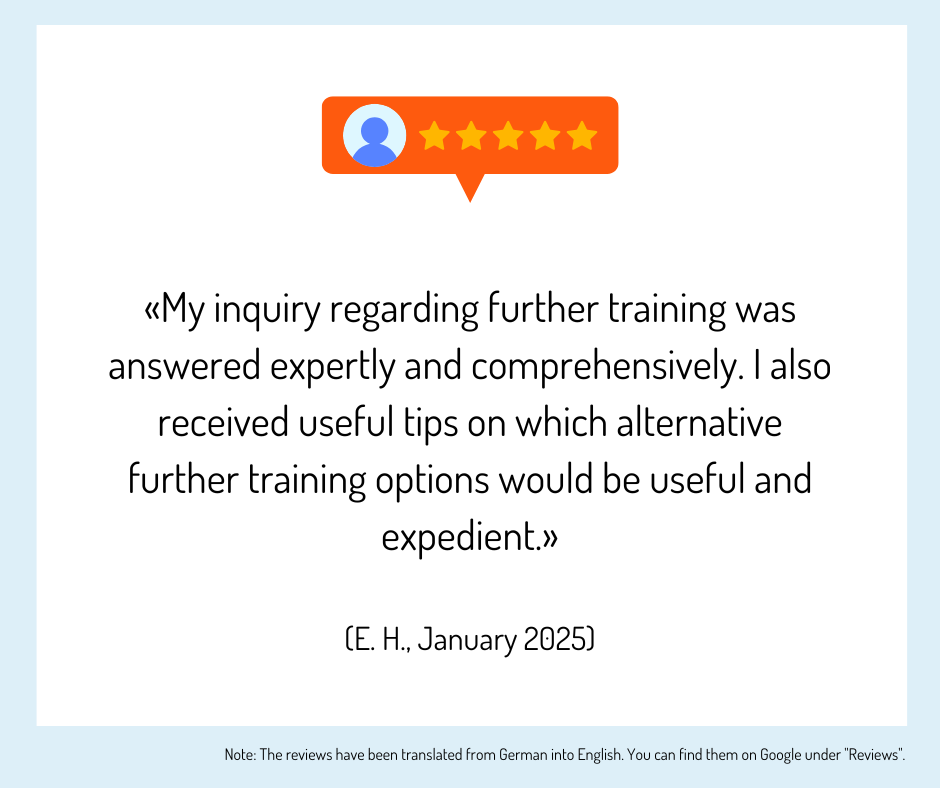
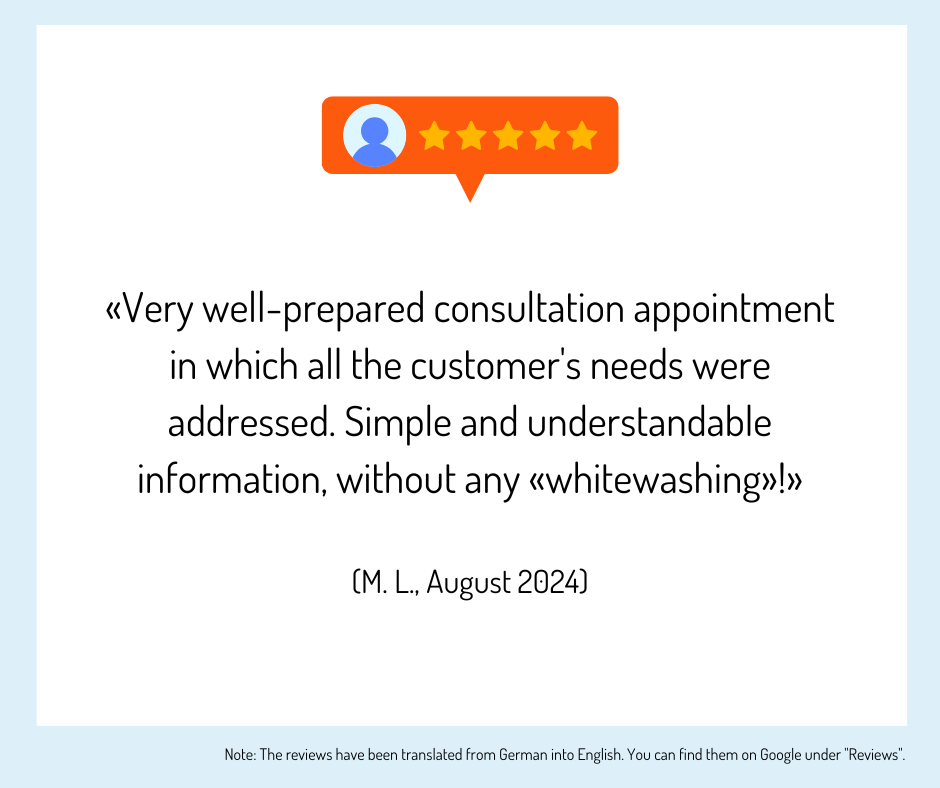
 Experiences, evaluations and opinions on training / further education
Haven't found the right training or further education yet? Benefit from educational advice now!
Further training is not only important in order to maintain or increase professional attractiveness, investing in training or further training is still the most efficient way to increase the chances of a pay rise.
The Swiss education system offers a wide range of individual training and further education opportunities - depending on your personal level of education, professional experience and educational goals.
Choosing the right educational offer is not easy for many prospective students.
Which training and further education is the right one for my path?
Our education advisory team will guide you through the "education jungle", providing specific input and relevant background information to help you choose the right offer.
Your advantages:
You will receive
- Suggestions for suitable courses, seminars or training programs based on the information you provide in the questionnaire
- An overview of the different levels and types of education
- Information about the Swiss education system
We offer our educational counseling in the following languages on request: French, Italian, English
Register now and concretize your training plans.








Immediately to the right training
Grüentalstrasse 14
8820 Wädenswil

 Download info
Schools with certified educational counseling

Attraktive Services für Swisscom Mitarbeitende
Kostenlose Services
» Bildungsberatung (Wert: CHF 150.–)
Bildungs- und Businessratgeber (Wert: CHF 175.–)
» Rabatte
Attraktive Rabattierungen seitens der Bildungsanbieter.
» Massgeschneiderte Bildungsangebote
Ohne grossen Zeitaufwand den besten Trainer, Coach oder Schulungsanbieter finden
Bildungsangebot Schweiz
Aus über 700 Bildungsanbietern das richtige Bildungsangebot finden