Forklift license - necessary or not, how do I get it ...?
Here you can find out the most important information about training to operate forklift trucks.
Why do you need training to operate forklift trucks?
Stackers and forklift trucks powered by motors (known as industrial trucks) are used to move loads. Depending on the type of forklift truck, operation is associated with either low or increased risks.
The Employment Act obliges employers to ensure the health and safety of their employees. When using forklift trucks, they must therefore ensure that the employees concerned have the necessary knowledge.
The Swiss Federal Coordination Commission for Occupational Safety (FCOS) has published theGuideline No. 6518has been drawn up. It sets out the necessary knowledge, for example, which training standards apply to which forklift types, who is authorized to train, etc.
Attention: These guidelines apply to the operation of forklift trucks on company or factory premises. The conditions of road traffic law apply to driving on roads.
Two categories of forklift types: S (low risk), R (increased risk)
What does the forklift look like that you are supposed to operate?
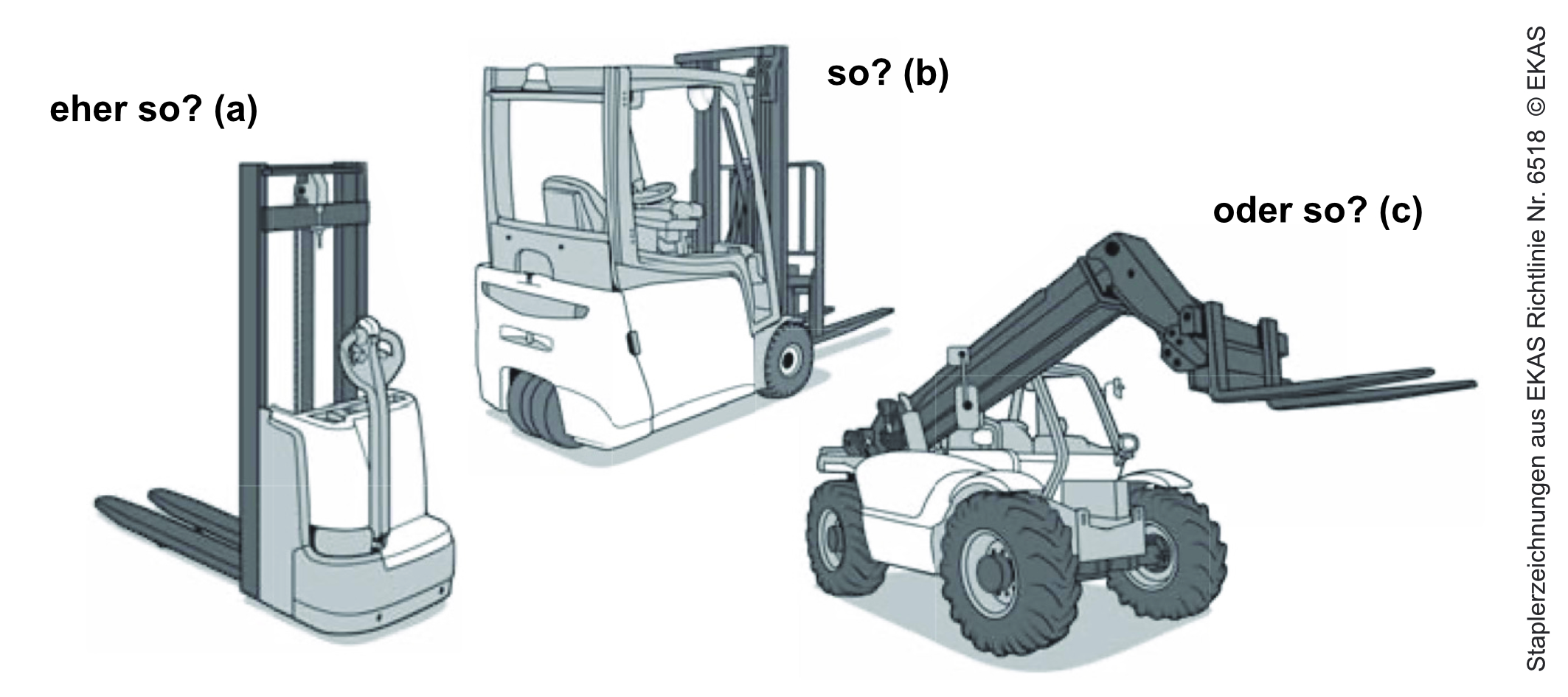
The FCOS guideline divides the different types of forklift into two categories:
- Category S: without special hazards (picture a); the loads are mainly transported on the surface or at a low height, there is no covered operator's seat or none at all, there may be a standing platform. This includes
- S1 Tow tractor
- S2 pallet truck
- S3 Order picker
- Category R: with special hazards (pictures b + c)The forklifts are equipped with a driver's seat or operator's platform and can lift loads overhead; forklifts where the operator travels at a great height (over 5 m) with the operator's platform. This includes
- R1 Counterbalanced truck
- R2 Cross-seat and high-rack stackers
- R3 Side and four-way forklifts
- R4 telescopic forklift.
The exact type descriptions in both categories (S1-3, R1-4) can be found in theEKAS Guideline No. 6518.
Do I need a forklift license? If so, how do I get one?
Whether you need a forklift license depends on the type of forklift you will be operating.
Forklift category S - require instruction
If you are to operate a category S forklift, i.e. one without a particular accident risk, you do not need forklift training, but you do need instruction. This means that you must be instructed in the use of a forklift truck type by a specialist from your company or an external trainer. Such instructions usually take place at the company. It is important that the instruction takes place before you use the forklift for the first time and that it is documented. The document must show when you were instructed on which forklift type and by whom.
Forklift category R - require training
If you are to operate a category R forklift truck, i.e. one with an increased accident risk, you must complete training. The training consists of basic theoretical training and two additional modules for two of the four categories R1-4. It also includes a learning drive and concludes with examinations in all modules. The training and the examination results must be documented. The document must show when you were trained, by whom, how and on which topics and forklift types, and how well you passed the examinations.
Instructor and SUVA recognition
Many companies have qualified employees who can provide instruction and training. There are also company-independent training centers that offer instruction and training. These take place either at the training centers or, on request, at the company. Companies and training centers can obtain confirmation from Suva that their training and examinations comply with EKAS Directive No. 6518.
Make sure that you choose a training course that complies with EKAS Directive No. 6518. Suva maintains a public list of training centers that meet the training standards: https://www.suva.ch/de-ch/praevention/nach-gefahren/maschinen-und-werkzeuge/stapler-flurfoerderzeuge/ausbildungsstaette-staplerpruefung
Minimum age and required skills
The minimum age for operating forklift trucks is 18. Exceptions are possible for trainees aged 15 and over, provided that operating forklifts is part of their vocational education and training (VET).
You need to be able to operate any type of forklift truck:
- Understanding of technical and physical relationships
- Reliable, responsible and prudent behavior
- Good health and eyesight
Duration of training (forklift category R)
The training concept for the basic training category R assumes a training period of 4 days. The actual training period depends on the skills of the candidates. Modest technical skills or poor language skills can extend the training period.
How much does the training cost?
The costs for basic forklift training category R (basic and 2 types) amount to around CHF 700-1300, depending on the intensity and form of the course. As a rule, employees bear the course costs, as they are responsible for training their employees in hazardous areas. Anyone who drops out of the course or quits their job soon afterwards may have to pay back part of the course costs.
What language skills are required for the forklift license?
You must be able to communicate well in the company. Sufficient language skills in the respective national language are therefore very practical. If language communication is difficult, the duration of training will be extended.
In the case of language problems or reading difficulties, the theory test can be replaced by a technical discussion.
Is there a difference between in-company training and training in an external training center?
Companies are free to organize training and instruction as they wish, provided they can prove that the level of training is equivalent and that the safety of employees is guaranteed. This means that training in the company may differ formally from that in training centers; however, both must convey the content specified by the FCOS directive.
The big difference lies in the validity of the forklift licenses:
- Training confirmations from companies are only valid for the respective company.
- Training certificates from training centers must refer to the EKAS Directive No. 6518 and are then valid for an unlimited period of time and location within Switzerland.
Only company or foreign ID card available: What now?
If you can provide evidence of previous or foreign forklift training, but it is unclear whether your level of training is sufficient, you will be admitted directly to the examination (basic module and additional modules). Depending on the result, you may then be recommended to repeat or refresh your training.
What happens if you drive a forklift truck without a permit?
If valid documentation of instruction (for categories S1-3) or proof of training (for categories R1-4) is missing, there are serious consequences for the employer in the event of damage or an accident at work. If a company allows employees to operate forklifts without such proof, it will be left without insurance cover in the event of an accident and will have to reckon with fines and liability claims.
Do you need support? We are in ourChat, in theEducational counselingor alsoby e-mailgladly there for you personally!
Share this article with your network - maybe the information will help someone else!

 Found an error?-