Financial planner (FPE) (Region Zentralschweiz):
2 Provider



Immediately to the right training
Aarauerstrasse 30
4601 Olten
 Strengths:
Qualified lecturers from the professional world, targeted knowledge transfer, modern infrastructure, Art. 32 catch-up training in classes with adults only, easily accessible.
Strengths:
Qualified lecturers from the professional world, targeted knowledge transfer, modern infrastructure, Art. 32 catch-up training in classes with adults only, easily accessible.

 Download info
Baarerstrasse 137
6302 Zug

Schools with certified educational counseling

Questions and answers
Which further education course can be attended after completing the Federal Certificate in Financial Planning?
Graduates of the specialist certificate in financial planning are eligible to attend the SME financial expert course with a federal diploma.
What is currently the most popular form of teaching for the IAF financial planner training course?
A recent survey of those interested in the IAF financial planner training program shows which forms of teaching are currently most popular:
- A third of those surveyed would like face-to-face teaching in schools.
- A good quarter prefer hybrid lessons, i.e. a combination of face-to-face and online lessons.
- A quarter would like to have purely online lessons so that they can learn anywhere and at any time.
- The remaining share has no clear preference and decides flexibly depending on the offer or personal situation.
The proportion of those in favor of face-to-face teaching has decreased slightly over the last few years. At the same time, interest in hybrid teaching has risen slightly, while the desire for online teaching and the group with no clear preference have increased slightly.
This development indicates that participants in the IAF financial planner training program are increasingly placing value on flexible and combined forms of learning. Depending on personal learning styles and time constraints, face-to-face, hybrid or online teaching may therefore be the right choice.
What is the interest in training as a financial planner (BP)?
Interest in a "Financial Planner (BP)" training course is triggered for various reasons. According to the training survey conducted by Ausbildung-Weiterbildung.ch, this happens equally often for the following three reasons:
- 80 % as the financial planner qualification with a federal certificate is mentioned in many job advertisements and is required for corresponding jobs.
- 17 % to compare further training with their own wishes and needs.
- 3 % showed interest in this further training in financial planning because it was recommended to them.
What leads prospective students to enquire about further training as a "Financial Planner (BP)"?
We have clarified this question about the financial planner course for you. According to a survey conducted by the education platform Ausbildung-Weiterbildung.ch, the reasons given by participants varied:
- 44 % read an online review
- 36 % already knew the school/s
- 20 % received a recommendation from a school for further training to become a financial planner
Further impacts are provided to us via text responses: "curiosity", "proximity to school" and "through job offer".
IAF Financial Planner Training: What are the most common types of learners?
Those preparing for the IAF Financial Planner training learn most effectively when their own learning strategy matches their personal learning type. An internal survey of interested parties on this training platform has shown that participants can be divided into four main groups:
- Visual learning types (32 %)
The best way to learn is by seeing and observing. Graphics, charts, learning videos or color flashcards help to understand complex financial relationships. - Motor or kinaesthetic learning types (34%)
Understand content most quickly by trying it out in practice. Exercises, case studies, calculation examples or playing through real customer situations provide optimal support for this type of learner. - Communicative learner types (25 %)
Learning is most successful through exchange and discussion. Group discussions, learning groups or explaining content to others significantly promote understanding. - Auditory learning types (9 %)
The best way to memorize information is through active listening - for example during lessons, listening to podcasts or learning content read out loud.
Incidentally, most people are mixed types who benefit from a combination of different learning methods. If you know your preferred way of learning, you can optimize your preparation for the IAF Financial Planner exam in a targeted manner - be it through video lessons, group work, practical tasks or audio learning materials.
Tip:
Try out different learning methods during your training and observe which ones help you achieve the greatest learning success. Consciously adapting your learning strategy can anchor the material more sustainably and make exam preparation much more efficient.
IAF Financial Planner: Which modules are tested for the Financial Planner certificate?
Various modules are examined in two stages for the Federal Certificate in Financial Planning IAF. These cover all the central topics of modern finance and pensions and form the basis for holistic financial advice.
- Level 1 - Basic modules
In the first stage, the most important specialist areas of financial planning are taught and examined:- Capital formation
- Pension provision (personal and social insurance)
- Insurance (property and asset insurance)
- Real estate and financing
- Law
- Taxes
- Level 2 - In-depth and integration modules
The second level builds on the basic knowledge and focuses on practice-oriented application:- Advanced pension provision and assets
- Integrated financial planning for private households
The examinations test whether prospective IAF financial planners have comprehensive specialist knowledge in the areas of investment, financing, pensions, insurance and tax planning. The ability to analyze and plan complex client situations holistically is also assessed.
Note:
The modules and exam content are based on the official specifications of the Interest Group for Training in Finance (IAF). Careful preparation for all modules - ideally via a recognized course provider - is crucial to successfully passing the final exam.
What are the admission criteria for continuing education, further training and Federal Professional Examination?
The admission requirements for the Financial Planner continuing education, further training with Federal Professional Examination are:
- Certificate of a vocational apprenticeship of at least three years' duration or an equivalent qualification and at least two years' professional experience in the financial services sector.
or
- Successful completion of two years of basic training and five years of professional experience, at least two of which must be in the financial services sector.
or
- At least five years of professional experience in the financial services sector.
and
- Proof of the following module qualifications or confirmation of equivalence as a financial planner up to 30 days before the start of the examination: asset formation, pension provision (personal and social insurance), insurance (property and asset insurance), real estate / financing. The module qualifications must not be older than 32 months.
The professional practice must be completed during the financial planner continuing education, further training until the start of the financial planner examination. The SFBI decides on the equivalence of foreign certificates and diplomas.
What activities do financial planners with a federal certificate carry out?
Financial planners with a federal diploma provide comprehensive advice to private individuals and, in some cases, companies on all financial matters. Continuing education, Higher Education or Federal Diploma of Higher Education in Financial Planning qualifies you to provide comprehensive, strategic financial advice.
The most important activities include:
- Holistic financial planning, including income, budget and asset structure
- Pension advice, e.g. AHV, pension fund and private pension provision
- Tax planning and tax optimization within the scope of legal possibilities
- Investment and wealth management advice tailored to your goals and risk profile
- Real estate and mortgage advice, e.g. financing of residential property
- Analysis of the overall financial situation and development of individual solutions
A Financial Planner continuing education, Higher Education or Federal Diploma of Higher Education in Financial Planning provides both specialist knowledge and advisory skills so that clients can be financially secure in the long term.
Conclusion: Financial planners play a central role in holistic financial advice and support clients in making important financial decisions. Find out about suitable continuing education, further training or request non-binding documents to enter this demanding professional field.
What do you learn about due diligence in continuing education, further training for financial planners?
The topic of due diligence plays a central role in continuing education, further training for financial planners. Participants deal intensively with the legal, ethical and professional requirements associated with the responsible management of client data and asset matters.
The focus is on the following topics, among others:
- Trust is the foundation: financial planners gain deep insights into personal financial circumstances
- Handling customer dossiers requires the utmost confidentiality
- It is important to take responsibility for careful and discreet action
- Legal requirements and professional duties of care must be consistently observed
- Developments on the financial markets and in the economy should be monitored on an ongoing basis and included in the advisory process
These topics form the basis for a professional and responsible activity in the field of financial planning.
As each school has its own slightly different focus beyond the guidelines of the examination organization, it is advisable to clarify this directly with the respective education provider. A question can easily be forwarded to the desired school via the contact form.
For whom is the Federal Diploma of Higher Education in Financial Planning suitable?
The Federal Diploma of Higher Education in Financial Planning is suitable for people who already work in the financial or insurance sector and would like to develop their skills in the direction of holistic financial advice. A Financial Planner continuing education, Higher Education or Federal Diploma of Higher Education in Financial Planning builds on your professional experience and significantly deepens your specialist knowledge.
Typical target groups are:
- Employees in banks, insurance companies or trust companies
- Persons from the financial advisory or investment advisory sector
- Specialists in the field of pension, tax or investment advice
- Career changers with relevant previous training and professional experience in the financial sector
The Federal Diploma of Higher Education in Financial Planning is particularly suitable for anyone who wants to advise clients holistically on topics such as budgeting, pensions, taxes, real estate and asset accumulation. It not only teaches product knowledge, but also builds up comprehensive financial planning skills.
Conclusion: The Federal Professional Examination is ideal for financial professionals who want to expand their advisory skills and develop their career to a higher level in finance. Find out about suitable courses or request non-binding documents to plan your next career move.
What skills does financial planner training teach?
Graduates of a financial planner training program with a federal certificate have the necessary expertise, particularly in the areas of asset accumulation, pension planning and retirement planning, to provide private households with comprehensive advice and support. Solid knowledge in the areas of taxes, law, insurance and real estate round off the competence profile.
Create a financial plan: What can you do as a financial planner IAF and with a Federal Diploma of Higher Education?
As an IAF financial planner with a Federal Diploma of Higher Education, you can provide private individuals with comprehensive financial advice and support throughout their entire life cycle up to retirement as part of private financial planning. This means creating a financial plan for:
- Build-up planning (financial planning build-up) - personal financial plan or strategic financial planning
- Financial plan for house purchase
- Pension planning
The respective schools are happy to provide detailed information about the course content and the skills taught. Contact the right school quickly, easily and without obligation using our contact form.
Tips, tests and information on "Financial planner with Federal Diploma of Higher Education"
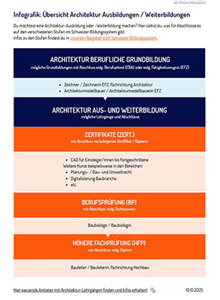


 Error found? -
Experiences, evaluations and opinions on training / further education
Haven't found the right training or further education yet? Benefit from educational advice now!
Further training is not only important in order to maintain or increase professional attractiveness, investing in training or further training is still the most efficient way to increase the chances of a pay rise.
The Swiss education system offers a wide range of individual training and further education opportunities - depending on your personal level of education, professional experience and educational goals.
Choosing the right educational offer is not easy for many prospective students.
Which training and further education is the right one for my path?
Our education advisory team will guide you through the "education jungle", providing specific input and relevant background information to help you choose the right offer.
Your advantages:
You will receive
- Suggestions for suitable courses, seminars or training programs based on the information you provide in the questionnaire
- An overview of the different levels and types of education
- Information about the Swiss education system
We offer our educational counseling in the following languages on request: French, Italian, English
Register now and concretize your training plans.
Attraktive Services für Swisscom Mitarbeitende
Kostenlose Services
» Bildungsberatung (Wert: CHF 150.–)
Bildungs- und Businessratgeber (Wert: CHF 175.–)
» Rabatte
Attraktive Rabattierungen seitens der Bildungsanbieter.
» Massgeschneiderte Bildungsangebote
Ohne grossen Zeitaufwand den besten Trainer, Coach oder Schulungsanbieter finden
Bildungsangebot Schweiz
Aus über 700 Bildungsanbietern das richtige Bildungsangebot finden