Dipl. Betriebswirtschafter / Dipl. Betriebswirtschafterin CHE: Overview of schools, information, tips, experiences, videos



What does a business economist CHE do?
Questions and answers
What is the difference between the "Betriebswirtschafter / Betriebswirtschafterin CHE" course and postgraduate studies in Higher Education in Business Administration?
The "Betriebswirtschafter / Betriebswirtschafterin CHE" and "Betriebswirtschaft NDS CHE" courses can be distinguished as follows:
- CHE courses, such as Business Administration CHE, provide generalist specialist and management knowledge within the respective specialist area.
- Postgraduate CHE courses offer the opportunity for further specialization and in-depth study as well as the acquisition of additional specialist knowledge.
- CHE courses generally last between 2 and 4 years.
- Postgraduate studies CHE usually last 1 year.
What both have in common is that they are recognized by the State Secretariat for Education, Research, and Innovation (SERI).
Which fields of activity must HF business economists master?
Business economists HF are proficient in the following fields of activity:
- Corporate management / Leadership
- Marketing / Public Relations
- Production
- Procurement and logistics
- Quality, environment and safety
- Human Resources Management (HRM)
- Financial management and accounting
- Computer science and technology
- Organizational design / development
- Project management
Dipl. Betriebswirtschafter HF - what next?
As a qualified business economist HF, there are numerous opportunities for further development in the area of higher professional examinations, higher technical colleges or universities of applied sciences, for example:
- Shortened Bachelor of Science (FH) degree course in Business Administration with various specializations
- Expert in organizational management with a federal diploma
- Certified expert in accounting and controlling
- Graduate Head of Human Resources
- Certified public accountant
- Certified fiduciary expert
- Certified tax expert
- Postgraduate courses at universities of applied sciences and universities of applied sciences in the fields of accounting and finance, marketing and sales management, real estate management, leadership and management, etc.
- Further courses at higher technical colleges and universities of applied sciences for further training in business administration HF / Betriebswirtschafter HF
The opportunities for further training are therefore numerous and the degree course can lay a good foundation for your future career. All-rounders are sought after in all areas of management and all sectors. And you can also start building up your own company after completing this HF course.
Why are people interested in the "Business Economist HF / Business Economist in HF" course?
The education platform Ausbildung-Weiterbildung.ch conducted a survey to clarify this question and came to the following conclusions:
- 67 % are still clarifying whether further training in business administration suits their needs
- 25 % are interested in further training in business administration based on a recommendation
- 8 % are interested, however, because the degree is required in job advertisements
The additional comments from survey participants provide even more reasons for their interest in continuing education in Business Administration HF:
- "Description of a school about further education"
- "As a technical business graduate, I would like to take advantage of the Passarelle opportunity because I am interested in advancing within the company"
- "I informed myself"
- "Due to the assumption of management tasks in the company"
What does the CHE examination of the degree program in Business Administration usually include?
The CHE examinations of the degree program in Business Administration are practice-oriented and serve as proof of the skills acquired during the degree program. They usually include the following elements:
- Regular performance assessments: These include written assignments, group projects or traditional examinations. Subject knowledge, social skills and methodological and practical skills are assessed.
- Final examination: This consists of a written thesis and a subsequent oral examination. The content is based on the respective study focus.
The examinations are held on site at the respective College of Higher Education. These schools have recognized training courses that are subject to an official recognition procedure. Upon successful completion, a federally recognized diploma is awarded. Graduates are entitled to use the protected title of Certified Business Economist CHE.
Subject overview (examples depending on the school):
- General Business Administration: Fundamentals of corporate management, organization and strategic management
- Finance and accounting: Bookkeeping, controlling and financial planning
- Marketing and communication: market analysis, brand management and communication strategies
- Law and economics: Introduction to commercial law and macroeconomic contexts
- Human resources: Employee management, personnel development and labor law
- Project and process management: planning, implementation and control of projects
- Digital skills: IT basics, data analysis and digital business models
The exact content and weighting for the CHE examination of the degree program in Business Administration may vary depending on the school and study orientation.
Important: The exact course content may vary depending on the school. It is recommended that you enquire directly with the desired educational institution. Use our contact form to easily forward your question to the relevant school.
How much does it cost to train as a business economist CHE?
The following costs are incurred for a business administration course leading to a degree in business administration CHE:
- Registration fee upon registration
- Possible entrance examination
- Semester fee
- Teaching aids
- Qualification procedure incl. diploma thesis
- Protestant seminary
- Possible tuition and examination fees for external language diploma
Depending on the training provider, the total cost of a business administration course leading to a degree in business administration CHE is between CHF 12,000 and CHF 20,000.
What content is taught during continuing education, further training in business administration (CHE)?
Continuing education, further training in business administration (CHE) provides practice-oriented know-how that prepares students for management positions in companies. The course covers a wide range of business management topics. Typical content includes
- Business administration: fundamentals of economic relationships and entrepreneurial decisions
- Corporate management: strategies, planning, control and organization of a company
- Controlling: cost accounting, budgeting and financial management tools
- Financing and investment: capital requirements, forms of financing and investment decisions
- Human resources: Recruitment, development and management of employees
- Marketing: market analysis, marketing strategies and customer loyalty
- Communication: internal and external communication, conducting conversations and presentations
- Computer science: Use of digital tools in business practice
- Project management: planning, implementation and control of projects
- Organization: structural and procedural organization and organizational development
- Quality, environmental and safety management: systems to ensure standards
- Law: Fundamentals of contract, labor and commercial law
- Economics: economic cycles, market mechanisms and economic policy interrelationships
- Statistics: collection, analysis and interpretation of operational data
- Business English: technical vocabulary and communication in an international context
- Team leadership: leadership, motivation and teamwork
The topics covered in continuing education, further training in business administration (CHE) provide a sound understanding of business management contexts and prepare students for a demanding specialist or management role.
Note: The exact content and focus may vary depending on the school. It is therefore advisable to enquire about the specific curricula directly with the respective educational institution. Using our contact form, the question can be easily forwarded to the desired College of Higher Education.
What can I achieve with the CHE Business Administration course?
According to graduates, you can achieve the following with a Business Administration CHE course:
- Solid continuing education, further training to build up a sound knowledge as a generalist in business administration
- Achieve the highest qualification in business administration in accordance with the Federal Vocational Training Act
- Holistic view of a company's business management issues
- acquire a broad knowledge of business, finance, marketing and process management
- Further development through the Business Economist CHE training in a personal and business environment
- apply the know-how you have acquired directly in your job thanks to its high practical relevance
- Achieve a goal- and customer-oriented, systematic and entrepreneurial way of acting
- Take on responsibility and management tasks in SMEs or large companies in operational management and in the business process or in support processes
- Take a leading role in projects of simple to medium complexity
- recognize economic, social and ecological change processes and develop solutions for sustainable development
- contribute to the achievement of corporate goals through a business-supported process optimization
- communicate with the relevant internal and external stakeholders
- Recognize influences and trends in the economic and marketing context and define measures on this basis
- Degree in Business Administration CHE with federal recognition and at NQF level 6
- Use contacts and established network in everyday working life
- Self-determined study focus through specializations in the 3rd year of the CHE Business Administration course
- Follow-up options through a shortened Bachelor's degree (UAS) at a University of Applied Sciences or postgraduate studies
Business economist HF jobs: What does a business economist HF do?
Jobs for business economists HF are in middle or upper management in SMEs and large companies. The managers fulfill demanding specialist and management tasks in business and administration. In doing so, they implement the goals of the management. Here you can read a list of exactly what a business economist HF does and what tasks are involved:
- Implement overall strategy at department or team level
- Adapt organizational structures and business and support processes in line with objectives
- Create profitability calculations and draw up benchmarks
- Developing a sound basis for management decisions
- Statistics, figures and cost plans
- Ensuring market leadership through technology and innovation management
- Quality assurance
Depending on the field of application, a job for a business economist may involve other tasks:
- Accounting and controlling: preparing annual financial statements, balance sheet, income statement, capital
- Human Resources: Recruitment, employee development and training organization
- Marketing and sales: developing marketing projects, determining product and sales policy
- Information technology: organizing data protection and security, IT projects
Why did prospective students enquire about a particular school or several schools for the "Business Economist (HF)" course?
When the education platform Ausbildung-Weiterbildung.ch asked prospective students as part of a survey, 37% stated that they had done so following a recommendation. 30 %, on the other hand, already knew the school before this inquiry for the HF Business Administration course. A further 33% enquired about a school after reading an online evaluation. Optional self-written responses from the education survey provided us with further reasons for enquiring about schools:
- "Geographical location"
- "I have a good impression of the technical business management training"
- "Found via Google and has good references - is therefore very attractive"
- "came across it on the Internet"
- "Distance"
- "Location"
- "Online offer as a hybrid course"
What degree do business economists (HF) obtain?
Graduates of the HF course in business administration with a federal diploma are awarded the federally recognized title:
"Graduate in Business Administration HF".
The following intermediate degrees are available at schools as part of the Business Administration HF program:
- Higher Business Diploma VSK (HWD)
- BEC Vantage / Higher Diploma
- Advanced Federal Diploma of Higher Education in Business Administration, Level 6 of the National Qualifications Framework for Vocational Education and Training (NQF)
- Professional Bachelor ODEC
- Bachelor of Arts (BA) Business Administration Dual Degree (Swiss/UK)
- IREB (Requirements Engineering)
- Cambridge English: Business Vantage
- IPMA Level D
What does a "Business economist HF shortened" course mean?
The HF Business Administration course normally lasts a total of 6 semesters. However, if you meet certain conditions, it is also possible to complete a shortened version. In this shortened version, the course only lasts two years.
As a rule, the following admission requirements must be met in order to be admitted to the shortened course:
- Federal diploma for technical business people, management specialists, management assistants, business organization specialists, higher business diploma or similar qualification
And
- EFZ as a commercial clerk and at least 2 years of relevant professional experience
Or
- Federal diploma for technical business people, management specialists, management assistants, business organization specialists, higher business diploma or similar qualification
And
- 3-year basic training (EFZ) in another profession or high school diploma with a focus on business and at least 3 years of relevant professional experience
The admission requirements may vary from provider to provider, so it is best to obtain information directly from the provider of your choice. In addition, admission is usually granted "sur dossier".
What is the difference between a degree in business administration (business studies) and a CAS course at a Universities on the subject of business administration?
A Bachelor's degree in Business Administration and a CAS (Certificate of Advanced Studies) course differ in terms of target group, scope, duration and type of qualification. Both qualifications teach business skills, but are designed for different educational phases and professional goals.
Important differences at a glance:
- Duration and scope:
A Bachelor's degree in Business Administration usually takes three years (full-time) and comprises 180 ECTS credits. A CAS course usually lasts one semester and comprises at least 10 ECTS credits. - Type of degree:
The business administration degree (Bachelor) leads to a first university degree with a federally protected and internationally recognized title. CAS courses, on the other hand, lead to a continuing education certificate that is not federally protected, but can be made internationally comparable via ECTS points. - Target group:
A Bachelor's degree course is aimed at people with a school-leaving certificate or a recognized equivalent qualification, possibly with professional experience. CAS courses are aimed at specialists with a university degree or comparable qualification and several years of professional experience who wish to continue their education. - Learning form:
Bachelor's degree courses are offered on a full-time or part-time basis. CAS courses are generally designed for part-time study and allow students to apply what they have learned in practice. - Content orientation:
While the Bachelor's degree course teaches broad-based business fundamentals, CAS courses focus on specialized topics and current issues from practice.
To summarize: A Bachelor's degree course offers a comprehensive introduction to business administration and lays the foundations for an academic and professional career. A CAS course is ideally suited for targeted in-depth study and further development of existing professional skills.
Important: The exact content and admission requirements may vary depending on the school or Universities. It is advisable to enquire directly with the desired institution. A contact form is available for support, which can be used to forward inquiries directly to the respective school.
Find out now - send questions about suitable training directly to the school.
Graduate in Business Administration: What is a College of Higher Education?
Colleges of Higher Education (CHE) are part of the continuing education and training / tertiary level of higher vocational education and training and offer practical training courses that provide in-depth specialist knowledge in the respective field. CHE courses also promote participants' specialist and leadership skills and prepare them specifically for responsible tasks in everyday working life.
CHE courses, such as those leading to a degree in business administration, are aimed at people with an upper-secondary level qualification and relevant professional experience in the respective field. The duration of a course is usually between two and four years, either part-time or full-time.
All courses at Colleges of Higher Education are recognized by the federal government and lead to a protected diploma that also allows access to Universities of Applied Sciences. The Confederation currently regulates eight CHE areas:
- Economy
- Technology
- Hospitality, tourism, housekeeping
- Agriculture and forestry
- Social affairs / adult education
- Health
- Traffic / Transportation
- Arts, creation and design
Colleges of Higher Education thus offer a practical, state-recognized further training opportunity to prepare students professionally and personally for taking on demanding tasks. This also applies to the business administration diploma course.
CHE Business Administration - BWL CHE: How much effort is the CHE Business Administration self-study program?
CHE Business Administration self-study requires good time management and a realistic assessment of your own learning effort. A survey of CHE Business Administration (BWL CHE) graduates provides a clear guideline of how much time students invest on average per week. The results show that the amount of time spent can vary greatly depending on learning style, prior knowledge and subject module:
- 1 % invest less than one hour per week in self-study.
- 8% study one to two hours per week.
- 20% spend three to four hours per week.
- 18% invest five to six hours per week.
- 19% spend seven to eight hours a week studying.
- 11% devote nine to ten hours a week to self-study.
- 8% study eleven to fifteen hours per week.
- 15 % invest more than fifteen hours per week.
These values show: The individual effort required for the CHE Business Administration degree course depends heavily on learning habits, workload and objectives. If you stay on the ball regularly and structure your CHE Business Administration self-study well, you can master the course material efficiently and benefit from the high practical relevance of CHE Business Administration in the long term.
How long does the Business Economist (CHE) course take?
Continuing education, further training in business administration (CHE) takes 3 years (6 semesters). However, there is also a shortened version. Holders of a federal certificate (or HWD) can complete the College of Higher Education in Business Administration (HFW) in just two years in this shortened version.
What are the admission requirements for continuing education, further training in business administration with a CHE degree?
The following admission criteria apply to continuing education, further training in Business Administration CHE:
- Federal VET Diploma commercial clerk or Federal VET Diploma retail specialist (direct access)
or
- Federal VET Diploma in another profession with at least 3 years of basic training and at least 2 years of professional experience in the commercial/business administration field (with an employment level of 80%)
or
- Baccalaureate or Specialized School and 2 years of professional experience in the commercial/business management field (with an employment level of 80%)
Further conditions:
- Employment of at least 70 % in the commercial/business administration area during continuing education, further training in business administration.
or
- An employment of at least 50% in the commercial/business administration area during the business administration training, if an employment of at least 80% in the commercial/business administration area was exercised for 2 years before the beginning of the continuing education, further training.
For further details, please contact the College of Higher Education.
Business administration continuing education, further training: What was the benefit of the last continuing education, further training?
A survey of graduates clearly shows the concrete benefits of continuing education, further training in business administration. The participants were able to benefit both professionally and personally from their training - with the following results (multiple answers possible):
- 66 % expanded their professional skills.
- 25 % gained more self-confidence.
- 24 % now appear more confident and convincing.
- 23 % can manage themselves better.
- 16 % achieved a wage increase.
- 12 % improved their teamwork skills.
- 11% developed better time management skills.
- 9 % achieved a promotion.
These results show: Continuing education, further training in business administration pays off in many ways - it not only strengthens your specialist knowledge, but also promotes personal skills, career opportunities and self-confidence in everyday working life. Those who continue their education in the field of business administration position themselves more successfully in the company and on the job market in the long term.
Tips, tests and information on "Betriebswirtschafter CHE / Betriebswirtschafterin CHE"
Test your vocation and career opportunities in business administration
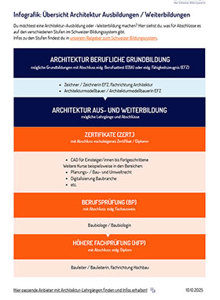


 Error found? -
 Experiences, evaluations and opinions on training/continuing education, further training
Haven't found the right training or further education yet? Benefit from educational advice now!
Further training is not only important in order to maintain or increase professional attractiveness, investing in training or further training is still the most efficient way to increase the chances of a pay rise.
The Swiss education system offers a wide range of individual training and further education opportunities - depending on your personal level of education, professional experience and educational goals.
Choosing the right educational offer is not easy for many prospective students.
Which training and further education is the right one for my path?
Our education advisory team will guide you through the "education jungle", providing specific input and relevant background information to help you choose the right offer.
Your advantages:
You will receive
- Suggestions for suitable courses, seminars or training programs based on the information you provide in the questionnaire
- An overview of the different levels and types of education
- Information about the Swiss education system
We offer our educational counseling in the following languages on request: French, Italian, English
Register now and concretize your training plans.
Training providers in your region
Hohlstrasse 535
8048 Zürich
 Strengths:
Higher vocational education and training with prospects: CHE, postgraduate studies CHE, specialist certificates and micro-courses in business, IT and real estate - practical, career-oriented and supervised by experienced lecturers.
Strengths:
Higher vocational education and training with prospects: CHE, postgraduate studies CHE, specialist certificates and micro-courses in business, IT and real estate - practical, career-oriented and supervised by experienced lecturers.


Andreasstrasse 15
8050 Zürich
Strengths:
Largest provider of HFW in Switzerland. 11 locations (incl. online location), modern learning methods and practical continuing education, further training with a focus on business, IT and digital skills for the future
 Experiences of Swisscom employees about this course and this school.
» More info…
Experiences of Swisscom employees about this course and this school.
» More info…
 Download info
Max-Daetwyler-Platz 1
3014 Bern
Strengths:
Individual advice, modern teaching and personal support are the basis for the educational success of our learners. We are constantly working on better solutions and new offers.
Lagerstrasse 5
8004 Zürich
Strengths:
The Institute for Vocational Education and Continuing Education, Further Training IBAW offers high-quality and practical training programs for private individuals and companies/institutions throughout Switzerland.
Download info
Bildungszentrum Sihlpost, Sihlpostgasse 2
8004 Zürich
Strengths:
Our training programs represent a benchmark, enjoy the highest level of recognition in the working world and create added value for everyone.
Download info
Strengths:
Many long-standing customers, excellent ratings and extremely high success rates do not lie: at the renowned SWS you can expect quality, flexible course times and a pleasant learning environment.
Download info
Emil Frey-Strasse 100
4142 Münchenstein
Strengths:
High level of practical transfer, personal advice and support, up-to-date teaching materials, lecturers with practical experience, location assessments, many years of experience.
Download info
Baarerstrasse 137
6302 Zug
Lagerhausstrasse 3
8400 Winterthur
Strengths:
Excellent customer reviews: 5.9 out of 6 on Ausbildung-Weiterbildung.ch | 4.9 out of 5 on Google with over 130 reviews | ISO 21001 and EduQua certified | College of Higher Education
Download info
Industriestrasse 78
4600 Olten
Strengths:
Your 5 Benefits: Guaranteed learning success in small classes | 93% pass rate on final exams | Instructors who are experts with real-world experience | Blended learning | Recorded classes
Download info
Wiesenstrasse 10A
8952 Schlieren
Download info
Josefstrasse 59
8005 Zürich
Strengths:
In the last customer survey in October 2021, participants were asked what MBSZ stands for. The answers were: flexible, familiar and uncomplicated. That makes us happy, thank you!
Experiences of Swisscom employees about this course and this school.
» More info…
Download info
Kreuzlibergstrasse 10
5400 Baden
Strengths:
You are our top priority; with personalized support, modern continuing education, and a strong focus on real-world experience, we’ll guide you on your path to new opportunities and professional growth.
Mönchstrasse 30A
3600 Thun
Strengths:
Largest provider of continuing education in the Bernese Oberland | Specialized provider of continuing education in business, IT and languages | More than 25 training courses and 50 courses on offer
Download info
Effingerstrasse 70
3001 Bern
Strengths:
- High-quality educational opportunities - Innovative "Learning Path+" - Personal orientation and support - Dedicated teaching staff - Practical training and follow-up opportunities - Interactive methodology
Download info
Strengths:
Inovatech has great expertise and works actively with representatives from the world of work. Students acquire skills that they can apply immediately in everyday life.
Download info
Winkelriedstrasse 35
6003 Luzern
Strengths:
Modular examination system - Maximum efficiency: the perfect mix of virtual and face-to-face teaching - Efficient study design - Lecturers with practical experience - Location at Lucerne railroad station
Download info
Verena-Conzett-Strasse 23
8004 Zürich
Strengths:
High level of practical transfer, personal support, industry-specific teaching materials, lecturers from the field, proven online model, location assessments
Download info
Weiterbildung
Bahnhofstrasse 46
5000 Aarau
Experiences of Swisscom employees about this course and this school.
» More info…

Aabachstrasse 7
6300 Zug
Pilatusstrasse 38
6003 Luzern
Experiences of Swisscom employees about this course and this school.
» More info…
Schützenstrasse 15
8808 Pfäffikon SZ
Schools with certified educational counseling

Attraktive Services für Swisscom Mitarbeitende
Kostenlose Services
» Bildungsberatung (Wert: CHF 150.–)
Bildungs- und Businessratgeber (Wert: CHF 175.–)
» Rabatte
Attraktive Rabattierungen seitens der Bildungsanbieter.
» Massgeschneiderte Bildungsangebote
Ohne grossen Zeitaufwand den besten Trainer, Coach oder Schulungsanbieter finden
Bildungsangebot Schweiz
Aus über 700 Bildungsanbietern das richtige Bildungsangebot finden