Job interview: Education, continuing education, further training, course, schools, info



Job interview: How to learn to score points
Questions and answers
Interview procedure/conduct: What content can be expected?
A job interview is rarely completely structured, but many interviews follow a similar procedure. If you prepare well, you can practise typical content and make a confident impression. The most common elements of the interview process include
- Welcome and introduction of the discussion partners
At the beginning, the people present usually introduce themselves. This is followed by a short, informal introduction. - Presentation of the company and the open position
The company explains the background of the advertised position, the most important tasks and the area of work. - Self-presentation
The applicant presents their own professional background, qualifications and personal strengths - often with a focus on relevance to the position. - Suitability issues
The interviewers ask specific questions about motivation, professional skills and personality in order to check the fit with the position. - Queries from the applicant
This is an opportunity to ask questions yourself - for example about working hours, development opportunities or the team. - Information on the further procedure
Finally, the interview partners provide information about the next steps in the selection process. - Farewell
The conversation ends with a brief thank you and a friendly conclusion.
A structured discussion helps both sides to make an informed decision. Familiarizing yourself with the typical phases increases the chances of a successful discussion.
Each school or provider can prioritize or adapt the specific content differently in detail. It is therefore worth asking directly which topics are the focus of the respective school. Use our contact form to forward specific questions to your desired school.
What is meant by a self-presentation interview? What is it for?
The self-presentation interview is still part of the standard program. But what does this mean and why is it carried out? And more importantly, what is expected and how can you score points with recruiters? Briefly explained: A self-presentation is a verbal introduction of yourself.
First of all, it should be noted here that preparation is also the be-all and end-all when it comes to the self-presentation for the interview. Spontaneity is not recommended here, as you run the risk of digressing (for example, not every point from your CV must/should be mentioned, but only those that are relevant or interesting for the vacancy/company) or getting stuck.
The self-presentation interview offers applicants the opportunity to present themselves well orally and to be convincing. The self-presentation offers the personnel/recruiters a kind of opportunity to check the written documents already submitted by the candidate, such as the letter of application and the CV. They have presumably already formed a picture here, which they now want to round off with the personal impression. Any inconsistencies between the presentation and the application, as well as any gaps that have not yet been noticed, can also be localized with the self-presentation in the interview. The presentation also serves to make a personal impression and to assess your personality.
Job interview preparation: What to look out for?
Good preparation for a job interview is crucial to make a positive impression and increase your chances of getting the job. It is particularly important that you prepare yourself both professionally and personally.
You should pay attention to this:
- Research companies:
Find out about products, services, values and current projects. - Read the job advertisement carefully:
Understand the requirements and consider how your experience fits in. - Know your own strengths:
Prepare examples that demonstrate your skills (e.g. teamwork, projects). - Practicing typical questions:
z. e.g. "Why do you want to work here?" or "What are your strengths and weaknesses?" - Prepare a self-presentation:
Explain briefly and clearly who you are and what sets you apart. - Choose suitable clothing:
Appear serious and adapted to the industry. - Ensure punctuality:
Plan enough time - it's better to arrive a little earlier. - Prepare your own questions:
Show interest, e.g. in the team, tasks or development opportunities.
Conclusion:
Successful preparation for the interview means that you know the company, can present your strengths clearly and appear confident. This will make you appear confident, professional and well prepared.
What should you not do at a job interview?
In a job interview, it's not just what you say that counts, but also your behavior. Certain mistakes can quickly leave a negative impression and significantly reduce your chances.
You should definitely avoid these things:
- Being unpunctual:
Arriving late looks unreliable and unprofessional. - Being poorly prepared:
Having no idea about the company or the job is a clear minus point. - Negative statements about former employers:
Criticism or blame comes across as unprofessional. - Unclear or evasive answers:
Shows uncertainty or lack of preparation. - Talking too much or too little:
A good conversation is balanced - not verbose, but not monosyllabic either. - Inappropriate clothing:
Too casual or unkempt quickly looks dubious. - Do not switch off your cell phone:
A ringing telephone is a classic mistake. - Arrogance or overconfidence:
Self-confidence is good, but arrogance has a negative effect.
Conclusion:
Above all, you should show professionalism, respect and preparation in the interview. Avoiding typical mistakes will significantly increase your chances of a positive decision.
What does a self-presentation job interview include?
The self-presentation interview is an important tool for applicants to promote themselves orally and directly to decision-makers. The personal presentation usually only lasts a few minutes and should therefore be prepared accordingly in order to score points in the best possible way.
The following points belong in a self-presentation interview:
- Name, age, origin
- Training incl. focus areas
- Practical work experience
- Learning successes, projects and graduation
- Personal interests
It is important to show the connection to the company!
Depending on the situation, aids (e.g. Power Point, flip chart) may be allowed in the self-presentation, in which case it can be somewhat creative. It is best to find out about this in advance during preparation.
The self-presentation interview should also be practiced: You can talk through it once in front of the mirror, recite it to a colleague or record yourself and see how you come across.

 Error found? -
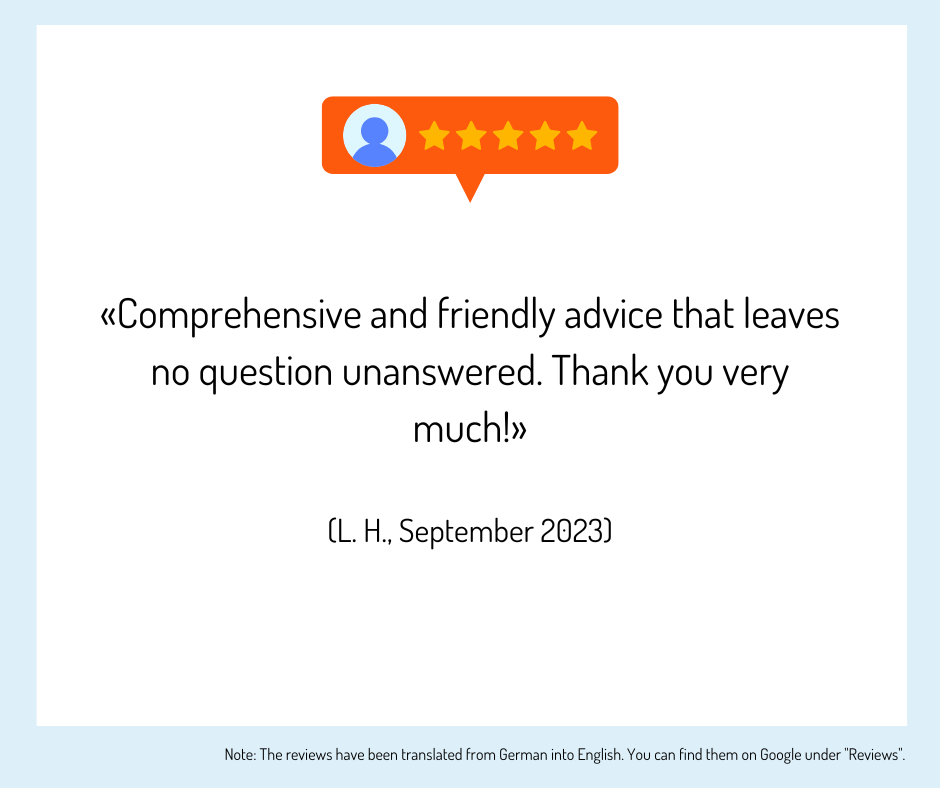
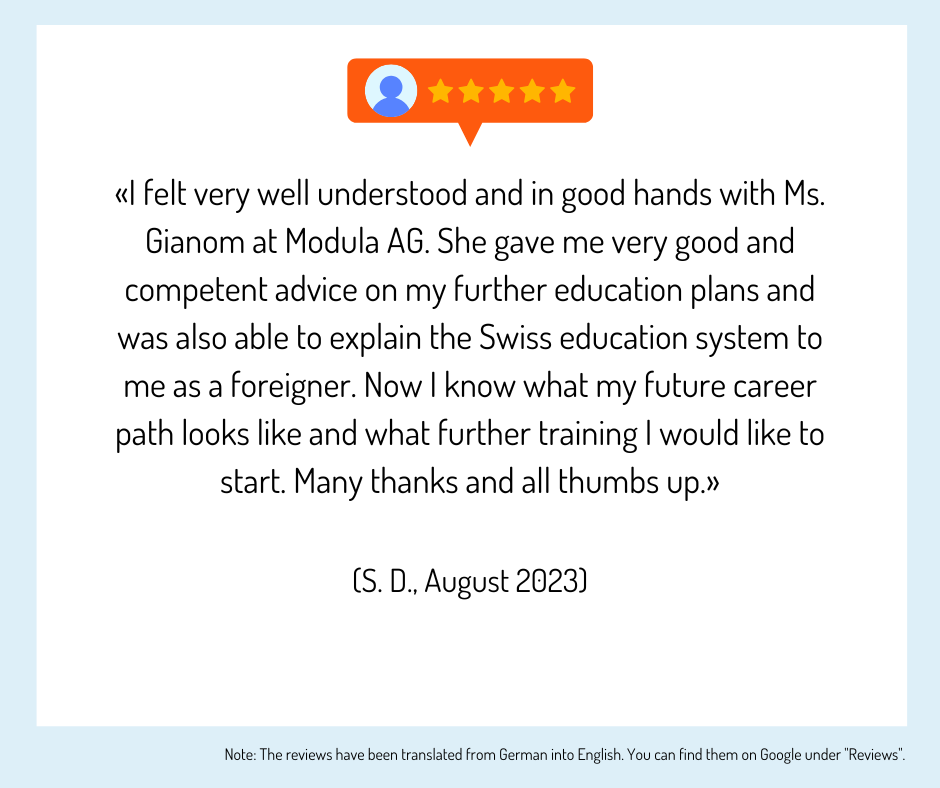
 Experiences, evaluations and opinions on training / further education
Haven't found the right training or further education yet? Benefit from educational advice now!
Further training is not only important in order to maintain or increase professional attractiveness, investing in training or further training is still the most efficient way to increase the chances of a pay rise.
The Swiss education system offers a wide range of individual training and further education opportunities - depending on your personal level of education, professional experience and educational goals.
Choosing the right educational offer is not easy for many prospective students.
Which training and further education is the right one for my path?
Our education advisory team will guide you through the "education jungle", providing specific input and relevant background information to help you choose the right offer.
Your advantages:
You will receive
- Suggestions for suitable courses, seminars or training programs based on the information you provide in the questionnaire
- An overview of the different levels and types of education
- Information about the Swiss education system
We offer our educational counseling in the following languages on request: French, Italian, English
Register now and concretize your training plans.
Immediately to the right training
Obergrundstrasse 44
6003 Luzern

 Download info
Schools with certified educational counseling

Attraktive Services für Swisscom Mitarbeitende
Kostenlose Services
» Bildungsberatung (Wert: CHF 150.–)
Bildungs- und Businessratgeber (Wert: CHF 175.–)
» Rabatte
Attraktive Rabattierungen seitens der Bildungsanbieter.
» Massgeschneiderte Bildungsangebote
Ohne grossen Zeitaufwand den besten Trainer, Coach oder Schulungsanbieter finden
Bildungsangebot Schweiz
Aus über 700 Bildungsanbietern das richtige Bildungsangebot finden