Apply correctly: Offers and schools at a glance



Applying correctly: learning what really matters
Questions and answers
What role does the job advertisement play in applying correctly?
Analyzing the job advertisement plays an important role in the process of applying correctly.
A job advertisement that demands different skills and abilities for your future employee than you can provide is not a good idea. The rule of thumb is that you should meet around 80 percent of the requirements in order to apply.
When analyzing the job advertisement, also check whether there is a deadline to be met. Write down important terms or facts about the company from the advertisement or highlight them. Get a clear picture of the company: What is its image like? What is the financial situation like? What kind of corporate culture does it embody?
What does the personal network have to do with applying correctly?
Nowadays, the job market is becoming increasingly dynamic. As a result, employees and jobseekers are expected to be increasingly flexible, mobile and, above all, proactive when it comes to applying for jobs.
This also includes building up a personal network or self-branding or personal branding. It enables you to become active yourself, to communicate with others instead of waiting for suitable job advertisements. As a result, many job offers still go unnoticed.
Such a personal network can consist of different groups of people:
- For example, family members, relatives or friends from school, clubs or the military.
- Secondly, people with whom you have a little more distance. These could be former lecturers, teachers, work colleagues or even customers.
Each of them can act as an intermediary and help you with your job search.
How to apply correctly by e-mail?
Today, most job advertisements are posted online on the company's own website, on job portals or on business networks such as LinkedIn.
Some companies maintain their own application tool, which you can use to upload your application documents. Others expect you to send your application by e-mail and state the relevant e-mail address in the job advertisement.
Tip: Also pay attention to your own e-mail address. It should be legitimate, contain your name and not be that of your current employer.
The subject line should also be precise and appropriately worded. Avoid generic subject lines such as "Vacancy" or "My application", as these come across as unprofessional. Please note that some companies have several vacancies online at the same time and it should be immediately clear which position you are interested in.
You can either send the letter of motivation as a PDF attachment or directly as an e-mail text. If you choose the former option, remember to write an accompanying text anyway. This should also be written politely, respectfully and with correct grammar and spelling.
Tip: Send the e-mail to yourself first. This allows you to check whether any line breaks are displayed correctly.
If no e-mail address is given, it is best to ask the contact person in which form you should submit your application documents.
What is necessary for a correct application?
A complete application dossier and therefore a correct application always includes a letter of application/letter of motivation, a CV/resume, copies of all references, professional and academic qualifications and (school) diplomas. Some also require a copy of school and training certificates with final grades.
A certificate of good character, an extract from the criminal record or a handwriting sample must only be enclosed on request.
It should be mentioned at this point that although a classic letter of motivation is still common, some companies no longer require this. So pay attention to this when applying and, if you are unsure, ask the contact person provided.
Apply correctly: How do I prepare for the interview?
In addition to the written application documents, the oral part, the job interview, is also part of the correct application process.
Here too, preparation is half the battle. You should consider the following points:
- Punctuality: Clarify the time required for the journey well in advance. If you are traveling by car, find out the route and clarify where you can park. If you are traveling by public transport, find out which train you need to take and how long it will take you to get from the station to the company headquarters. You may also need to take the bus or streetcar from the station.
- Outfit: Choose suitable clothes for the position. Make sure you look well-groomed: not too much make-up, hair brushed (for men: beard shaved or combed), fingernails well-groomed.
- Company: Find out more about the company, its activities and commitment.
- Questions: Prepare questions about the company, position or task. This will show that you have thought about it, which will earn you points.
- Answers: Think in advance about what questions may be asked and how you would like to answer them.
- Salary: Find out about the usual salaries in the industry and position and calculate your salary in advance. This way, you won't get flustered if you have any questions about your salary and will be able to make or justify your demands with confidence. Remember: salary negotiations also need to be practiced!
Apply correctly: What requirements must a letter of motivation fulfill?
The letter of application or letter of motivation is your personal business card and therefore an essential part of the correct application process.
A corresponding duty of care in its preparation is therefore imperative.
The text must not only be grammatically correct but also convincing in terms of content. As a rule, the letter of motivation should explain how you found out about the position, why you are applying, what skills, competencies, knowledge and professional experience you have and what your current position and activities are.

 Error found? -
 Experiences, evaluations and opinions on training / further education
Haven't found the right training or further education yet? Benefit from educational advice now!
Further training is not only important in order to maintain or increase professional attractiveness, investing in training or further training is still the most efficient way to increase the chances of a pay rise.
The Swiss education system offers a wide range of individual training and further education opportunities - depending on your personal level of education, professional experience and educational goals.
Choosing the right educational offer is not easy for many prospective students.
Which training and further education is the right one for my path?
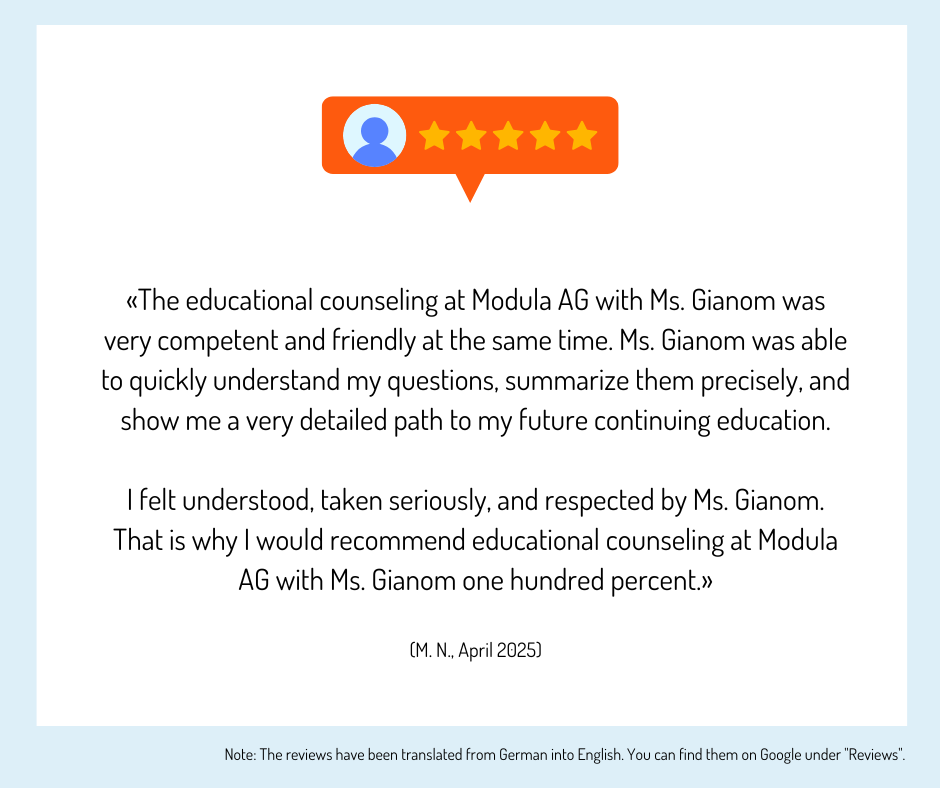
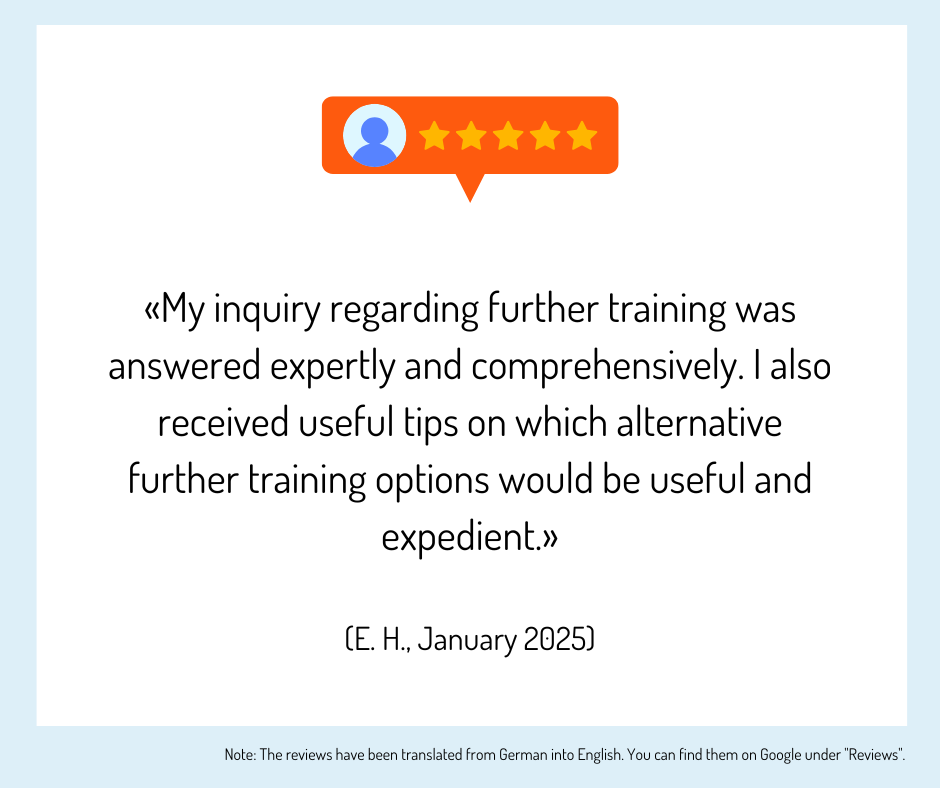
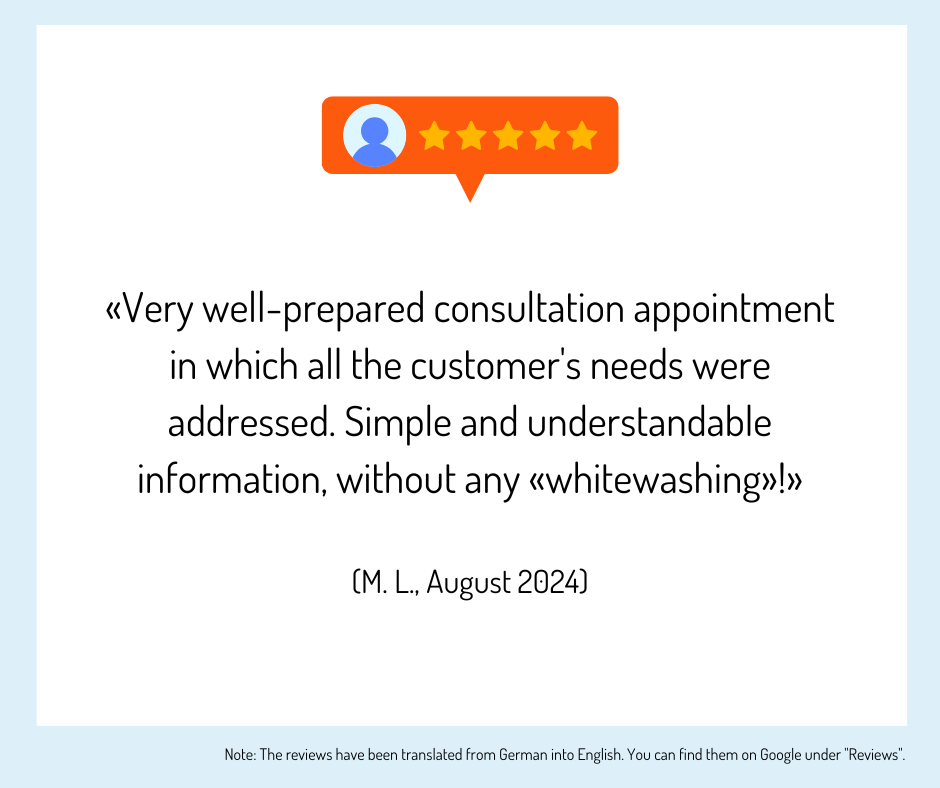
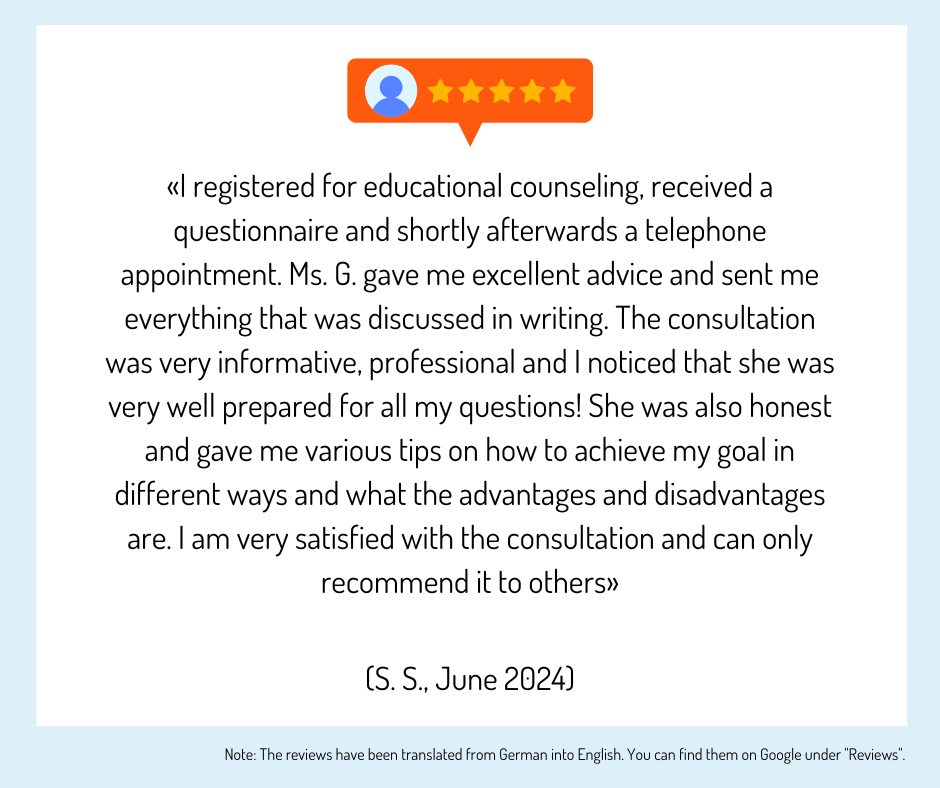
Our education advisory team will guide you through the "education jungle", providing specific input and relevant background information to help you choose the right offer.
Your advantages:
You will receive
- Suggestions for suitable courses, seminars or training programs based on the information you provide in the questionnaire
- An overview of the different levels and types of education
- Information about the Swiss education system
We offer our educational counseling in the following languages on request: French, Italian, English
Register now and concretize your training plans.


Immediately to the right training
Obergrundstrasse 44
6003 Luzern

 Download info
Schools with certified educational counseling

Attraktive Services für Swisscom Mitarbeitende
Kostenlose Services
» Bildungsberatung (Wert: CHF 150.–)
Bildungs- und Businessratgeber (Wert: CHF 175.–)
» Rabatte
Attraktive Rabattierungen seitens der Bildungsanbieter.
» Massgeschneiderte Bildungsangebote
Ohne grossen Zeitaufwand den besten Trainer, Coach oder Schulungsanbieter finden
Bildungsangebot Schweiz
Aus über 700 Bildungsanbietern das richtige Bildungsangebot finden