Self-test: Is the "Electrical Technician CHE" (formerly Technician CHE Electrical Engineering) course the right one for you?

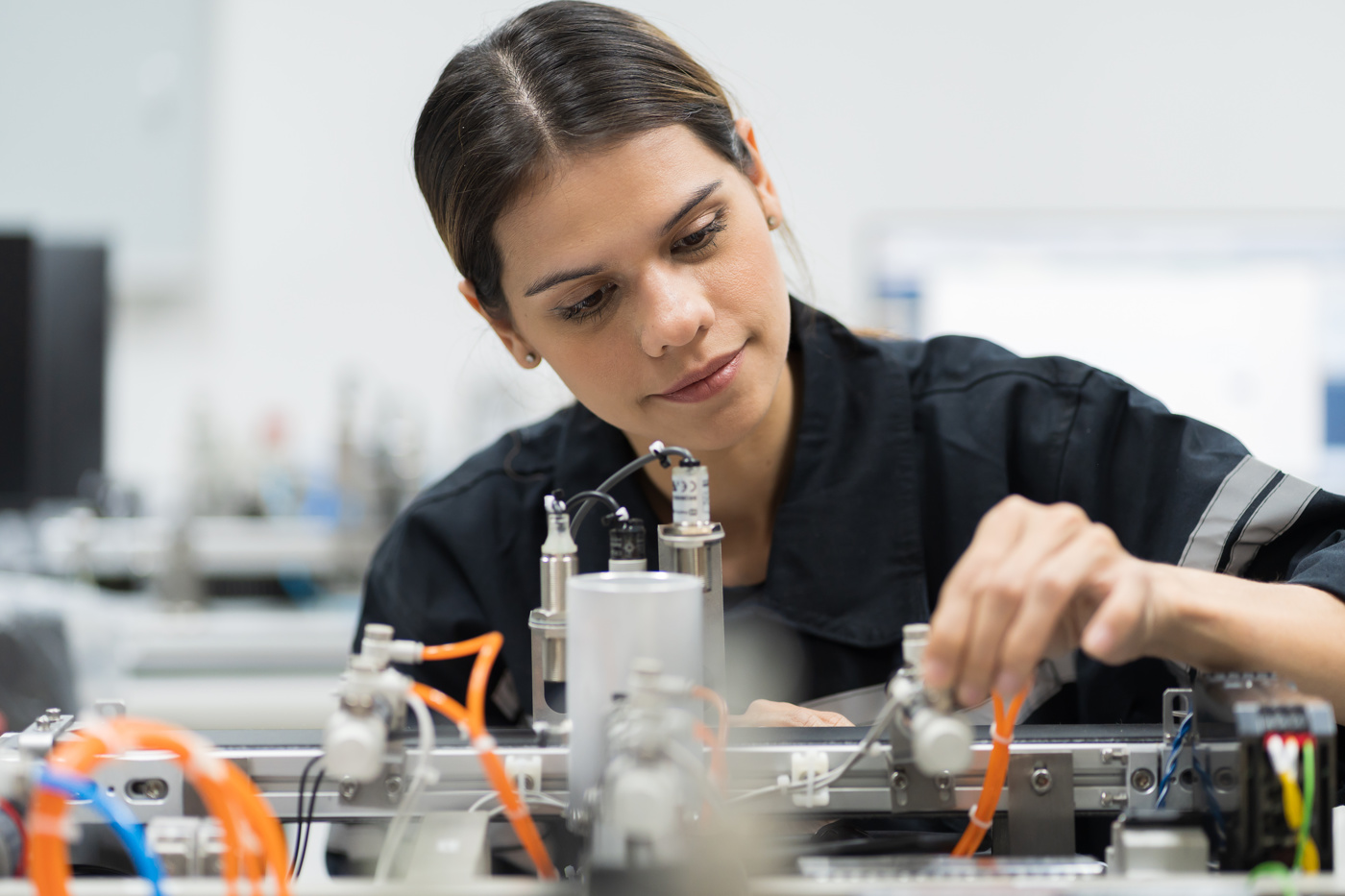
An electrical engineer CHE assembles an appliance and wires the individual electrical parts together.

Test here whether a job as an electrical engineer CHE (formerly electrical engineering technician CHE) is right for you and whether studying electrical engineering at a College of Higher Education (CHE) is right for you.

Note: Since fall 2022, the CHE technician courses (formerly "Techniker CHE Fachrichtung") have been given a separate framework curriculum and a new title for each specialization. For example, the course "Technician CHE Electrical Engineering" is now called "Electrical Technician CHE". In addition, the specializations in electronics and energy technology have been removed from the framework curriculum. (You can find out more about the possible specializations in the self-test)

Start

What does the everyday working life of electrical engineers with an Advanced Federal Diploma of Higher Education (Achtung: Engl.) look like?

Electrical engineers CHE work in companies in the electrical, electronics or machine industry as well as in service and IT companies. They manage projects for the development of electrotechnical systems and electronic circuits.

They also carry out tests and troubleshooting in systems and perform technical acceptance tests on devices and circuits. As specialists with a broad basic education, they are also equipped for responsible tasks in the test laboratory and test field, in service and sales or in advising and training customers. As a member of lower and middle management, they take on technical management tasks and develop concepts and technical solutions for complex areas.

Important to know: The distribution/weighting of tasks may vary depending on the company and job profile.

Question 1:

Do the activities described meet your expectations? Would you like to work as an electrical engineer CHE (formerly electrical engineering technician CHE)?

Target group and skills: For whom is the electrical engineering degree program for electrical engineers CHE suitable?

The CHE Electrical Engineering degree course at a College of Higher Education to become an electrical engineer CHE (formerly a technician CHE Electrical Engineering) is suitable for

  • Young professionals in electrical engineering / electronics who are preparing for a professional career
  • People who want to continue their education in the field of electrical engineering

Electrical engineers CHE should have the following personal qualities and skills:

  • Technical understanding
  • Sense of responsibility
  • Communication skills
  • Independent and reliable way of working
  • analytical and conceptual skills
  • Ability to work in a team

Question 2:

Do you belong to one of the target groups for this continuing education, further training and do you have the necessary personal qualities?

Requirements for admission to the CHE Electrical Engineering degree program:

The College of Higher Education (CHE) decides independently who is admitted to an CHE Electrical Engineering course and the admission procedure. For this reason, there may be differences between the providers.

The admission procedure is set out and regulated in the study regulations. It must comply with the relevant legal requirements*.

To be able to start an CHE Electrical Engineering course to become an CHE Electrical Engineer (formerly CHE Electrical Engineering Technician) at a College of Higher Education (CHE), you must generally meet the following admission requirements.

  • Completion of relevant vocational education and training with a Federal Diploma of Vocational Education and Training (VET) **

Or

  • Completion of a 3-year vocational education and training (Federal VET Diploma) in another field or high school diploma and relevant professional experience (usually at least 1 year) in the technical field

Further conditions:

  • During the part-time CHE Electrical Engineering course: at least 50% employment in the technical field.
  • Depending on the school: entrance examination or aptitude test and/or attendance of a preliminary course, for example in mathematics.

Note: In some cases, it is possible to have educational achievements already completed credited. Please contact the provider of your choice directly.


* College of Higher Education (CHE) courses are based on framework curricula that have been jointly developed by education providers and industry associations and approved by the State Secretariat for Education, Research, and Innovation (SERI). If the College of Higher Education adheres to existing framework curricula in the detailed design of its courses, its CHE courses are federally recognized and lead to a protected title.

** A list of the relevant Federal VET Diploma can be found in theFramework curriculumfor electrical engineers CHE.
Question 3:

Do you meet the requirements for admission?

Subject matter and content of continuing education, further training

The course content taught in a CHE Electrical Engineering degree program is generally based on the "Electrical Engineering CHE" framework curriculum.

The responsible body is made up as follows:

  • EIT.swiss, Swissmem and Swissmechanic (organization of the world of work, OdA)
  • Conference of Colleges of Higher Education in Technology KHF-T (representation of education providers)

The responsible body is responsible for drawing up the framework curriculum and for periodically reviewing it to ensure that it is up to date and of high quality.

Nevertheless, the Colleges of Higher Education have a certain amount of leeway in the design of their CHE electrical engineering degree programs. Which course content is ultimately covered and how it is structured or deepened can therefore vary from CHE to CHE. For example, the Colleges of Higher Education can also offer specializations*.

As a rule, the following topics are covered in electrical engineering training, continuing education, further training and studies:

  • Electrical engineering
  • Mathematics
  • Physics
  • Network technology
  • Measurement technology
  • Drive technology
  • Marketing
  • Law
  • Finance and accounting
  • Controlling
  • Leadership, Management
  • Project management
  • Business administration
  • Automation
  • Personnel management

*Such a specialization may focus on a maximum of 10% of the total learning hours. The protected title "Dipl. Elektrotechniker / dipl. Elektrotechnikerin CHE" remains unchanged.

Question 4:

Are you interested in this content, would you like to acquire knowledge in these subject areas?

Costs and financing of continuing education, further training

The costs depend on the provider, the training location and the training model and can therefore vary. In general, the following costs can be expected for the 6-semester CHE Electrical Engineering degree course:

  • Tuition feesThe semester fee depends on the school and your canton of residence. You can expect to pay between CHF 13,800 and CHF 19,800 for students resident in the canton of training*. The costs for the examinations and diploma thesis are usually included in the course fees.
  • Additional costsSome providers charge extra costs for the registration fee and the student ID card, preliminary courses, teaching materials, special software, licenses, laboratory exercises, practicals, training documents, examinations/diploma theses and examination retakes. Find out about the additional costs directly from the CHE of your choice.

* Courses at Colleges of Higher Education (CHE) are financially supported by the cantons. Students from outside the canton pay higher tuition fees. The following conditions apply in order to receive cantonal funding:

  • at least two years of residence in the canton
  • The course is listed on the EDK (Swiss Conference of Cantonal Ministers of Education) list of eligible courses (you will find the link to the list in the reply texts).

Question 5:

Are you able to pre-finance approx. CHF 13,800 - CHF 19,800 for your studies and examination/diploma thesis?

Duration of study, number of lessons and learning effort

  • Duration of study:The modular CHE electrical engineering degree course to become a qualified electrical engineer CHE (formerly a technician CHE electrical engineering) takes 4 semesters full-time and 6 semesters part-time*
  • Number of lessons:With a relevant Federal VET Diploma, the course comprises 3600 learning hours. For courses without a relevant Federal VET Diploma, the number of learning hours generally increases to 5400 learning hours; please contact the school of your choice. The professional activity (practice in relevant professional activity) during the part-time CHE Electrical Engineering course is credited with a maximum of 720 hours (with a relevant Federal VET Diploma) or a maximum of 1800 hours (without a relevant Federal VET Diploma) towards the training period. The practical training (internships in a practice-oriented or real field of work accompanied by specialists) in full-time studies amounts to at least 720 hours (with relevant Federal VET Diploma) or at least 1800 hours (without relevant Federal VET Diploma). Learning hours also include contact studies (with qualified supervision), guided self-study, individual self-study and qualification procedures (e.g. semester examinations, intermediate examinations, diploma examinations, diploma theses or assessed semester theses). How these learning hours are divided up in terms of time is defined in the framework curriculum.
  • Training models:The part-time or full-time CHE Electrical Engineering course is offered at different times. There are both daytime and evening options, for example one full day and one evening per week, two weekdays per week or three half-days per week.
  • Teaching format:Many schools offer a mix of face-to-face and online courses (online, hybrid teaching, blended learning).
  • Learning effort:You should allow sufficient time to prepare for and follow up on the lessons and for self-study - how much depends on your prior knowledge, working style, learning speed and chosen training model. We recommend that you allow at least 4-6 hours per week for the part-time model.

* At some schools, professionals with a technical Federal Vocational Baccalaureate can benefit from a shortened course of study. Please contact the school of your choice directly.

Note: Some schools offer so-called "taster lessons"/"trial lessons". This gives you the opportunity to gain an insight into the lessons and the learning atmosphere. Important aspects on the way to a successful graduation. Take the opportunity and contact the school of your choice directly.

Question 6:

Can you find the time for lessons and self-study?

Degree, diploma and title

The qualification procedure for the CHE Electrical Engineering degree course to become a qualified electrical engineer CHE (formerly a technician CHE Electrical Engineering) is generally as follows:

  1. The results of the previous semester examinations and/or assessed semester papers (so-called experience grades)
  2. Diploma thesis: The diploma thesis is practice-oriented; candidates have the opportunity to demonstrate their knowledge, skills and networked thinking. The thesis is written individually on a topic relevant to electrical engineering. It is written at the end of the course (can also be integrated into the 5th or 6th semester). Here too, the time frame is determined by the respective CHE in its study regulations.
  3. The thesis is also presented to a panel of experts (a group of specialists) and then defended in a discussion.


Diploma and title

Graduates of the course receive an Advanced Federal Diploma of Higher Education (CHE) and are entitled to use the federally recognized and protected professional title "Dipl. Elektrotechnikerin / dipl. Elektrotechniker HF HF".

In French: "Technicienne diplômée ES en génie électrique / Technicien diplômé ES en génie électrique"

In Italian: "Tecnica dipl. SSS in elettrotechnica / Technico dipl. SSS in elettrotechnica"

In English: "Advanced Federal Diploma of Higher Education in Electrical Engineering" (note: not a protected title, this is merely a recommendation)

Question 7:

Do you have the confidence to pass the College of Higher Education for the CHE diploma?

Have you already made up your mind?
Or would you like to know more?

Show schools of course «Electrical engineering (CHE)» and get information